



 0
0

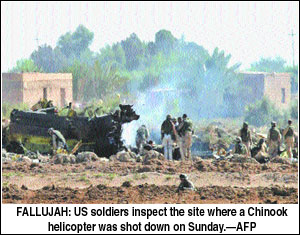 BAGHDAD, Nov 2: Fifteen soldiers were killed when a US military helicopter was downed on Sunday in the deadliest attack on American- led coalition forces since their March invasion of Iraq.
A US soldier was also killed in a separate bombing in Baghdad while witnesses reported four more wounded in an attack on a US convoy near the scene of the chopper strike outside Fallujah.
A roadside bomb blast in Fallujah killed two US civilian contractors working for the US Army Corps of Engineers and wounded one other, a Corps spokesman said.
This brings the total US death toll in Iraq to 18.
US Defence Secretary Donald Rumsfeld acknowledged the spiralling coalition losses did not make for a “pretty picture” but vowed to “ take the war on terror to the terrorists”.
“At approximately 9:00 am (0600 GMT) local time, a US CH-47 of the 12th Aviation Brigade, in support of the 82nd Airborne Division, made a crash landing approximately one mile southwest of Fallujah,” said US army Colonel Bill Darley.
“As a result of the crash, 15 were killed in action and 21 wounded,” the spokesman said, referring to coalition troops, without specifying if all the casualties were Americans.
Another coalition spokesman said those killed were “probably” all Americans.
If confirmed, Sunday’s deaths would raise to 138 the number of Americans lost in Iraq since Washington declared major combat over on May 1, according to an AFP count based on a previous toll provided by the Pentagon.
“We are aware of eyewitnesses seeing what they presumed to be missile trails,” said Col Darley.
Although listing 36 casualties, a spokesperson in Baghdad said 25 passengers and five crew were aboard the helicopter, which was travelling with another Chinook that carried a further 25 people.
The helicopters were ferrying the soldiers to go on leave after months patrolling the mainly Sunni Muslim tribal belt west of the capital, considered a bastion of support for Saddam Hussein’s Sunni- dominated regime.
In Washington, Rumsfeld said the chopper was likely hit by a portable surface-to-air missile.
“We’ve known about surface-to-air missiles since before we went in,” he told NBC television. “They are dangerous and they exist in that country in large numbers, as they do in that part of the world. So it’s always a risk.”
It was at least the fourth time since May 1 that the coalition has reported an attack on a helicopter by anti-US forces, but the first to cause fatalities.
The latest attack came in the wake of a warning on Friday by the US State Department of “credible information that terrorists have targeted civil aviation in Iraq.”
The US consular office in Baghdad also warned there were reports of “possible missile attacks directed at aircraft.”
The attack further coincided with widespread rumours in Baghdad of “a day of resistance” over the weekend, which marked six months since US President George W. Bush declared major combat operations over.
The US defence secretary insisted the new losses would not deter Bush’s administration from continuing its global war on terror.
“The only thing to do is... to take the war on terror to the terrorists,” Mr Rumsfeld told NBC television. “You can’t just hunker down and hope they don’t hit you again.”
He acknowledged that the situation in Iraq “isn’t a pretty picture” but insisted: “The president has every intention of staying after the terrorists and the countries that harbour terrorists until we have won this war.”
Iraq’s US overseer Paul Bremer was equally defiant. “We are not going to be deterred,” he told CNN.
He said there were signs the attacks against coalition forces were getting more organized, but added there was “no evidence” that Saddam was behind them.
Britain’s special representative to Iraq, Sir Jeremy Greenstock called for the violence to be seen “in proportion.”
“It’s a nasty atmosphere to work in, but it’s not as though a lot of things were not going right,” he said.
Foreign ministers from Iraq’s six neighbours plus Egypt urged the coalition to speed up the handover of power to Iraqis after a two-day meeting in Damascus called to address the threat to the region’s stability posed by the worsening violence.
A joint statement urged the United Nations to “enhance” its “vital role in Iraq” in supervising the drafting of a constitution, organizing elections and fixing a timetable to accelerate the end of the US-led occupation.
Promising to back the interim administration until the election of a representative government, the document also rejected frequent US warnings to Syria and Iran not to interfere in the affairs of its oil-rich neighbour.
But Mr Bremer reiterated the allegations against Syria on Sunday saying that Islamic militants whom Washington blames for much of the violence were “mostly” infiltrating from Iraq’s western neighbour.
The Damascus meeting had sparked a diplomatic row between Iraq’s US-installed transitional leadership and the neighbouring governments after interim foreign minister Hoshyar Zebari took to the airwaves on Saturday to announce a last-minute boycott. Mr Zebari insisted an 11th-hour request for him to attend the meeting did not constitute an official invitation. But Egyptian Foreign Minister Ahmed Maher criticised the Iraqi snub as a wasted opportunity.—AFP



























