0
0

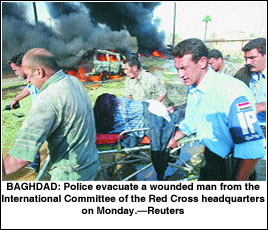 BAGHDAD, Oct 27: Guerillas orchestrated a series of bold attacks around the Iraqi capital on Monday, killing 43 people and wounding 216 in suicide car bombings of the International Committee of the Red Cross (ICRC) offices and four police stations.
The choreographed bombings, which plunged the capital into terror, also brought the bluntest charges yet by US officials that foreigners are fighting in Iraq.
The ICRC announced in Berlin it had decided to begin pulling foreign staff out of Baghdad. The organization has some 35 foreign staff in Iraq country and 800 local workers.
Brigadier General Mark Hertling, a US spokesman, said the five suicide bombings bore all the hallmarks of foreign fighters.
“We have not seen attacks we could attribute to foreign fighters before. We have seen those today,” the general said.
The assertions came after months of warnings by US officials of the Al Qaeda group and the Ansar al Islam being active in Iraq.
But a top US commander discounted foreign fighters as a significant factor.
Major General Raymond Odierno, commander of the US Army’s Fourth Infantry Division, said foreign fighters accounted for only “a very, very small percentage” of the forces resisting the US occupation.
Gen Odierno spoke to reporters in a video-teleconference from his headquarters in Tikrit, former president Saddam Hussein’s home town.
The bombings, which shrouded the Baghdad skyline in smoke, were an ominous start for Ramazan as the anti-US fighters escalated their campaign from bleeding the occupation forces with ambushes to apparently executing mass terror.
A US soldier died in the blasts, raising the US military’s number of dead to 113 since official combat was declared over on May 1.
The attacks came a day after a barrage of rockets pounded a hotel in the US_led administration’s heavily-guarded complex, housing Deputy Defence Secretary Paul Wolfowitz, and left one US soldier dead and 17 wounded.
In another blow, three US soldiers were killed and four wounded on Sunday night around the capital.
45 MINUTES OF THUNDER: The pinprick assaults, a mortar strike on Abu Gharib prison and a roadside bombing, came hours before a loud explosion rattled Baghdad at about 8.30am (0530 GMT) on Monday, ushering 45 minutes of thundering booms around Baghdad.
Gen Hertling said the five attacks started with two simultaneous blasts at the police stations in Al Bayaa, also known as Al Elam, and Al Dora, south of Baghdad. Fifteen minutes later, an explosion took place outside the International Committee of the Red Cross (ICRC) headquarters, 10 minutes after that another blast targeted a police station in the northern Al Shaab district and at 9.15am (0615 GMT) a blast struck a station in the western Al Khadra neighbourhood.
Another attack was foiled at 10.10am (0710 GMT).
At the ICRC offices, an Iraqi hospital ambulance rammed into a barricade in front of the building, bursting into flames and sending a thick black cloud of smoke over the city.
“An Iraqi hospital ambulance sped toward us. I waved my arms to stop it. It barrelled into the barrier blocking the headquarters and burst into flames,” said ICRC guard Saba Ali Ihsan.
Burnt-out vehicles smouldered on the street. The ambulance was a twisted heap of metal and glass shards scattered on the ground, as people screamed for those missing inside the ICRC building, while the wounded, streaming blood from head wounds, wandered aimlessly.
But the assault on the ICRC was not the only carnage.
Thirteen people, including three policemen, were killed at the Al Elam police station when a white car exploded. The US military said the blast killed one of its soldiers and wounded six others.
“We found many pieces of my colleagues on the ground,” policeman Abdel Zahar Salim said.
The car crashed into the station’s parking lot and burst into flames as 40 policemen gathered to start work.
The flames swept up four American military vehicles and 36 police cars, turning the parking lot into a pyre.
One policeman was killed at the Al Khadra police station, in southern Baghdad, when a car laden with explosives rammed into the building.
Three civilians were also killed and four Iraqi policemen were wounded in the attack.
At the same moment, seven or eight people were wounded when a suicide car bomber rammed into a neighbouring building as police at the Al Shaab station opened a fire at the speeding vehicle.
A policeman said the station had earlier received a letter that it would be attacked.
At the Al Jadida station, Gen Hertling said, a man claiming to be Syrian was captured. A US military official earlier said the man had been shot dead by police when his car hurtled toward the station.
MILITARY PROTECTION: Pierre Gassmann, head of the ICRC delegation in the Iraqi capital, said on Monday night the agency would continue to refuse military protection.
“If we decide to ask for military protection, we will be exactly where the enemy is seen — at the side of the coalition troops,” he said.—AFP