0
0

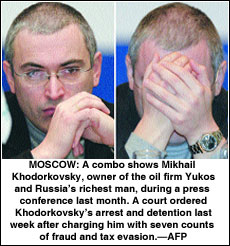 MOSCOW, Oct 27: Russian President Vladimir Putin faced his first market crash on Monday that analysts said was of his own making as political turmoil engulfed the country in the run-up to December’s parliamentary elections.
After hitting all-time highs, the Russian market plunged 10 per cent on the first day of trading after the weekend arrest of Yukos oil chief Mikhail Khodorkovsky on fraud charges.
Some top traders said it would take a week for investors to find their footing and at least another month for the best emerging market performer in the world this year to start recovering its gains.
The head of Russia’s largest oil company was detained at gunpoint at a Siberian airport on Saturday and later charged on seven counts that included tax evasion and profiting more than one billion dollars from illegal dealings.
But his case has an added political dimension: The country’s richest man has funded at least three opposition parties and many analysts believe he was being hounded by secret service agents who make up a powerful faction within the Kremlin and now have Putin’s ear.
The presence of the so-called “siloviki” faction in the administration has unsettled investors and liberal politicians amid fears that they are out to get a share of top Russian companies by reviewing the many shadowy privatization deals of the past decade that Putin had vowed not to touch.
Khodorkovsky’s arrest “raises serious doubts about progress toward the rule of law and the separation of powers in the country,” said a senior US diplomat before adding that “we have seen these tendencies (in Putin) before”.
Putin did little to cheer investors by flatly turning down a weekend plea from the country’s business elite to hold an emergency meeting aimed at defusing the standoff.
“There will be no meetings, no bargaining about the activity of law enforcement agencies,” Putin said.
Many said that statement delivered final proof that Putin preferred top-down Kremlin command — which at times plays well with the voters — before the Dec 7 parliamentary poll.
Disappointed analysts said Putin had committed at least two political mistakes, ones unlikely to dent his own re-election chances in March next year, but which may have seriously altered the West’s attitude to doing business with Russia.
First, Putin failed to show his authority by taking charge of the Yukos crisis as it unfolded between the “siloviki” and holdovers from the old Boris Yeltsin regime — which backed Yukos — over the summer.
That standoff has since unravelled into one of the most destabilizing conflicts in Russia in years.
His second mistake, said analysts, was to eventually side with the hawkish Kremlin clan against those who supported big business, frightening investors and prompting charges that the Kremlin was selectively using the law for its own political gain.
“Everyone is a loser, very much including president Putin himself,” the United Financial Group said in a research note.
Besides internal Kremlin struggles, Khodorkovsky’s arrest has broader political implications in the run-up to the parliamentary elections.
Oligarchs like Khodorkovsky who made billions while the rest of Russia suffered through poverty remain widely unpopular in Russia.
Several analysts suggested that Putin has opted for this crackdown in a bid to boost support of the main pro-Kremlin faction, United Russia, as it struggles against the Communist Party — which is also running on an anti-oligarch platform — before the vote.
“The point here is to raise the authority of United Russia,” said Yevgeny Volk of the US-based Heritage Foundation office in Moscow.
But now, some analysts said, a seemingly non-descript parliamentary election campaign threatens to explode into Putin’s face, since the arrest could suddenly galvanize the anti-Kremlin vote.
“This is the most serious political crisis to unfold since Putin took charge of the Kremlin,” Lilya Shevtsova of the Carnegie Moscow Center, told Moscow Echo radio. —AFP