



 0
0

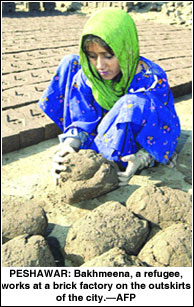 PESHAWAR, Oct 23: Zabihullah was just two when his family fled Afghanistan’s civil war to work in a Pakistan brick factory, but though war is over, they remain trapped far from home by crippling debts which they may never be able to repay.
Though Zabihullah, now 25, has worked with his extended family moulding bricks from clay for 18 years, their subsistence income means they are unable to pay back an advance of 28,000 rupees to their employer.
Thousands of Afghan refugees like Zabihullah are working as bonded labourers at brick kilns in the NWFP. They want to return home but the heavy debts prevent them.
They are among 3 million Afghans given asylum in Pakistan after fleeing fighting during the 1979-89 Soviet occupation of their country, an ensuing civil war and years of drought.
And while hundreds of thousands of their countrymen are gaining assistance to head back to Afghanistan, the brick workers, mostly hailing from the Nangarhar province, have slipped through the aid net.
Having failed to register in official camps, they have been denied official refugee status.
“There are some 300,000 to 400,000 unregistered refugees in the NWFP out of which 28,243 families, a total number of 185,178 individuals, are living outside the camps,” said Fayaz Ahmad Durrani of the Commissionerate of Afghan Refugees (CAR).
The CAR was doing everything to facilitate the repatriation of refugees but due to lack of resources it was unable to tackle the bonded labour issue, Mr Durrani said.
“Men, women and children are compelled to work as bonded labourers and they are sinking deep under debt every passing day,” said Mir Ali, secretary-general of the All Afghanistan Federation of Labour Union.
The refugees, after taking shelter in Pakistan, obtained loans from kiln-owners and agreed to work with them until they repaid their debt. But many were forced to take further loans to meet their daily expenses, Mr Ali said.
Some families owe more than 75,000 rupees, but due to low wages, even those who owe just 5,000 rupees are unable to pay off their debts and head home.
“The workers are being paid about 150 rupees for making 1,000 bricks — too meagre to save anything for debt repayment,” Mr Ali said, adding the daily brick quota was an impossible target even for a large family.
The UN’s High Commissioner for Refugees, which has helped more than 1.5 million Afghans return home, has no exact figure for refugees working as bonded labourers, but said it was investigating the matter.
“UNHCR is in touch with the brick kiln-owners through our advice and legal aid centres to sort out the issue,” said a UNHCR spokesman.
According to the Afghan repatriation ministry’s Peshawar representative Imamuddin Barez, the bonded labourers were a low priority for the country as it struggles to its feet.
“Even the refugees repatriated by UNHCR are jobless and the government finds it very hard to provide them employment inside Afghanistan,” Mr Barez said.
The brick kiln-owners reject allegations that they are holding the Afghan refugees in bondage, insisting the workers are free to go once debts, mainly incurred to pay for weddings and healthcare, are paid.—AFP



























