



 0
0

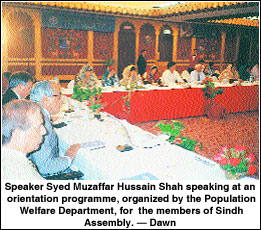 KARACHI, Oct 22: While most of the government departments complain of shortage or lack of resources, nearly Rs500 million, which comes to about 25 per cent of the total budget of the population welfare ministry, lapsed last year, the audience were informed at a seminar.
The orientation seminar on “Population and Development” was organized by the Sindh Population Welfare Department for the parliamentarians so that they, being influential people in their respective areas, could create awareness and spread the message regarding the effects that the unchecked population growth was having on the nation.
Some very alarming data was presented by the speakers — to the audience comprising nearly 30 members of the Sindh Assembly — showing that though the population growth had been brought down slightly, it was the highest in the region and more than those of many Islamic countries.
Sindh Assembly Speaker Syed Muzaffar Hussain Shah urged the NGOs, CBOs and communities to join hands with the government to bring down the population growth to a desirable level, as it was a difficult goal which the government alone could not achieve.
He stressed that political will was necessary to bring about a change in the government policy, and expressed the hope that after listening to the startling data provided at the seminar they would bring the population planning policy on their list of priorities.
He regretted that so far the parliamentarians had not brought up the issue in the Sindh Assembly and the situation could not be much different in other houses of the parliament in the country.
Sindh Population Welfare Minister, Imtiaz Ahmad Shaikh, said that keeping in mind the important role that the parliamentarians could play, and to apprise them of the serious issue, the orientation seminar was organized.
He said that unchecked population growth had neutralized whatever little economic growth the country had achieved in the past and the number of people living below the poverty line had increased over the years.
Referring to the information regarding last year’s lapsed funds, he said the department had always been facing shortage of resources, and now that the information had come that funds were not only available, but had lapsed, he would try to put forward more programmes so that the people, particularly those living in the remote rural areas, could also be provided with better reproductive health facilities.
Federal Population Welfare Minister, Shakil Durrani, urged the provincial government to try to make workable programmes to utilize allocated funds. He said that approximately 25 per cent of the population welfare budget — which was around Rs2 billion — had lapsed as the programmes could not be implemented in time.
He further said that despite last year’s poor performance, this year the budget had been increased to Rs3 billion, and he hoped that the departments would function properly and efficiently and the funds would be spent judiciously and in time. Earlier, other speakers said that eight districts — two in each province — had been selected for pilot projects.
The data collected by the National Institute of Population Studies Islamabad, 2003, which was given at the seminar, says that while Pakistan has an area of around 0.796 square million kilometres (which is around 0.6 per cent of the earth), its share in the world population is 2.36 per cent.
It says Pakistan in 1950 stood at number 14 in the world with a population of 33 million, and now it stands at the 6th position with its 148 million population. The population growth reached an all time high between 1961 and 1972, when it was over 3.66 per cent.
The data shows that the population of Pakistan is increasing at a rate of around 2.06 per cent, and would double in 34 years, while the population of Bangladesh (growth rate 1.7 per cent) would double in 41 years, Iran (1.2 per cent) in 58 years, India (1.7 per cent) in 41 years and Indonesia (1.6 per cent) in 44 years, while the population of the developed countries increased at 0.1 per cent and would double in 700 years.
The data shows that nearly 43 per cent of the population is below 15 years of age and nearly three per cent is above 65 years, while the rest, around 54 per cent, is in the reproductive age group —15 to 64 years.
It says that soon this 54 per cent of the population would also be entering the reproductive age group and if an awareness was not created and services were not provided in time to them, the growth will be uncontrollable.
“Nearly 67 per cent of the people live in rural areas, while the rest 33 live in urban areas. Every minute eight children are born and two people a minute die, which translates into an increase of six people in a minute — or over 3.144 million people a year — which means that every year a population as great as that of Albania, or New Zealand, is added to the country’s population.
It shows that Pakistan with 34 per cent of contraceptive prevalence rate is at the bottom of the list which includes different Islamic countries like Iran (74 per cent), Turkey (64 per cent), Morocco (58 per cent), Indonesia (57 per cent), Egypt (56 per cent), Malaysia (55 per cent) and Bangladesh 54 per cent).
According to the data, due to the efforts made by the government and NGOs awareness level regarding contraceptives has increased over the years from 78 per cent in 1991 to nearly 96 per cent this year.
Similarly the use of contraceptives has increased from 12 per cent in 1991 to 34 per cent this year, and the total fertility rate — number of children that a woman has during her life — has also come down from 5.4 to 4.3 during the same period.
Showing the neutralization impact of the population growth on the national economy, the data says that in 1950 the gross domestic product (GDP) was Rs20 billion, and this year it is Rs4018 billion — a 200 times increase — similarly per capita income which in 1950 was $79, has become $492 — a six times increase.
It says that during the same time the population of Korea has increased from 20 million to 48 million, while her per capita income has increased from $82 to $17,300.
The number of employed people in 1970 in Pakistan, it says, was around 18.5 million, which has increased to 39.4 million this year—two times more, while during the same time the number of unemployed people has grown from 0.4 million to 3.3 million — eight times greater.
Abid Ali Shah of the department, Shahida Fazil of UNFPA, and others also spoke. Later question-answer session followed.
The MPAs who attended the seminar are Rahila Tiwana, Dr Nasreen Khan, Begum Gulzar Unar, Farida Baloch, Rajvir Singh, Jam Madad Ali, Mir Ali Nawaz Talpur, Abdul Razzak Rahimoon, Dr Ramesh Kumar, Fariha Razak Haroon, Dr Manzoor Leghari, Eshwar Lal, Sakina Banu, S. Ali Bux Shah, Mahmood Alam Jamot, Sultan Ahmad Khahwar, Abbas Jafri, Afshan Imran, Naila Inam, Dr Rani Ambreen, Qamar Mansoor, Rehana Nasreen, Fareena Ambreen, Heer Ismail Soho, Asma Sherwani, Aziz Fatma Qazalbash, Karim Dino Shah and others.




























