0
0

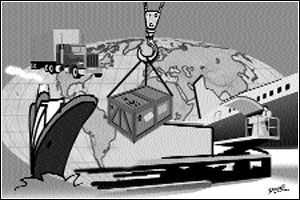 Another opportunity was missed to remove or reduce the inequalities and deficiencies in the global trade system, following the collapse of the WTO negotiations at Cancun.The colapse was caused by the rigidity of views displayed by the countries of North, on the core issues of tariff rationalization and subsidies on agricultural products.
The developed countries, specially the USA and the EU insisted on maintaining protection to their agricultural commodities against the same products, originating from the developing countries, which in most of the cases are their principal exports. They (developed countries) were bent upon to further relax the movement of direct foreign investment (DFI)) and trade regulations to the detriment of the interest of the developing countries.
The subsidies, being given by the rich countries to their agricultural produce are estimated more than $300 billion annually, which serve as a major deterrent to the expansion of trade of developing countries, by rendering their products uncompetitive both at home and abroad. Maize imported from the USA in Mexico is three times cheaper than the locally-produced. In fact, the component of subsidies far exceeds the aggregate imports of agricultural commodities by the developed countries.
Meanwhile, the products of developing countries, are subjected to high tariff and non-tariff barriers, as compared to the products being imported from the developed countries. This could be evidenced from the fact that a shirt imported by the USA from Bangladesh becomes 20 time more expensive than the same imported from the UK.
The developed countries are eager to ensure free and unhindered movement of goods, but pose multiple restrictions on goods of developing countries. The WTO agreement envisages lesser tariff reduction on goods mainly produced by the developing countries, as compared to developed countries including textiles, leather, carpet etc. The use of antidumping laws and adherence to social standard, environment etc. is already on the increase.
The emerging scenario from the failure of Cancun will contribute to spate of trade disputes, growing regional protections, particularly due to sluggish pace of economic recovery of the major world trading countries. At the same time, the possibilities of world trade expansion and particularly of developing countries are ruled out, paving the way for rising spectre of unemployment. The redeeming feature of the conference was the outstanding unity that was manifested by the developing countries and the coordinated strategy that was adopted by the developing countries through a newly created Group of 22 in collaboration with the Africa bloc.
In the ultimate analysis, the South-Worth gulf itself would be enlarged, as long as one-sided neoliberal system would continue to safeguard the interests of multinational corporations, the fountain-head of the in-flow and out-flow of DFI. Meanwhile, the developing world continues to be exposed to the vulnerability of directionless trading system.
The world trading system, which is executed through the charter of WTO lacks consistency in its direction and is devoid of uniform strategy, to accomplish the objective of free global trade. Resultantly, the free trade remains most unfair due to a variety of factors. The cardinal principle of Most Favoured Nation (MFN) treatment, stipulated by WTO to conduct the multilateral trade, is not being universally and equally applied, as a consequence of the existing clauses in the WTO charter itself. The reciprocity, which must be the corner-stone of a sustainable multilateral trading system, is conspicuous by its absence.
The full implementation of the WTO agreements, which started in 1995, will take place in January 2005, in the wake of phasing out of Multi-Fibre Arrangement (MFA). It is noteworthy that still a large number of countries, including Russia, Iran and Saudi Arabia and most of the countries of Middle Fast, are outside the pale of WTO. Thus, two sets of the rules of international trading would remain operative.
Although economic globalization stipulates boundaryless trade, through removal of physical and fiscal barriers, so that the process of multilateralism, envisaged by GATT and thereafter by WTP are reinvigorated. At the same time, growth of regionalism through formation of groups/blocs is being pleaded as a mechanism to ultimately achieve the goal of multilateralism, although both concepts negates each other. The existing trading system, therefore, does not provide even playing field to both the developed and developing countries and is discriminatory in its application. It has an in-built conflicting mechanism for multilateralism, regional and bilateralism. The quest for a just and equitable world trading system continues to persist unabated.
The membership of the WTO gives a country the legal right of not to be discriminated against in its trade with the other members of the organization. The principle of nondiscrimination in trade is set down in the WTO’s most-favoured nation (MFN) criterion. The MFN rule requires that tariffs and trade regulations should be applied to imported goods without discrimination among countries. In addition, every WTO member is entitled to seek redress against any impairment of its rights by another country through the dispute settlement system. The growing number of disputes speaks volume on the judicial character of the system.
Simultaneously, as per GATT (Article XXIV), regarding the Territorial Application - Frontier Traffic-Customs Unions and Free-Trade Areas, the contracting parties recognize the desirability of increasing freedom of trade by the development, through voluntary agreements, of closer integration between the economies of the countries, parties to such agreements. They also recognize that the purpose of a customs union or of a free-trade area should be to facilitate trade between the constituent territories and not to raise barriers to the trade of other contracting parties with such territories.
The only feeble safeguard provided in the law is that with respect to a customs union, or an interim agreement leading to a formation of a customs union, free trade and the duties and other regulations of commerce imposed at the institution of any such union or interim agreement in respect of trade with contracting parties not parties to such union or agreement shall not, on the whole, be higher or more restrictive than the general incidence of the duties and regulations of commerce applicable in the constituent territories prior to the formation of such union. Exponent of multilateralism advocate that the legal foundations for more open trade have been laid by the multilateral trading system - global in its coverage - with regional integration agreements serving to deepen relations with neighbouring countries. It is, therefore, irrationally claimed that “the regional and multilateral integration initiatives are complements rather than alternatives in the pursuit of open trade.
How the member countries of a regional trading arrangement (RTA) can maintain a balance with their multilateral obligations. There are tariff and non-tariff policies, their investment and transfer of technology policies are discretionary against the third world. Regional and international liberalization of trade cannot go together without causing distortion and imbalance.
The RTAs have made their own models of trade and rules of conduct, which has rendered the global trade more complex and complicated. Although the tariffs have been reduced, but the protectionism is being adopted through non-tariff barriers. These blocs are inward-looking and are being rightly described as the fortresses. The European Union and the USA are providing subsidies to their agricultural products which according to an estimate, comes to $ 1 billion a day. There import inputs enjoy rebates.
The globalization, which is characterized by free movement of goods, capital and privatization, has unfolded many problems than opportunities. While the goods and commodities, emanating from developed countries can find easy entry into the developing markets, their access in the developed market is conditioned by a variety of factors including conformity to the social and environment standards.
It is noteworthy that according to an estimate, the developing economies during 1960-80 grew at the rate of 3.5. per annum, whereas during 1980-2000, their growth was reduced to 1.4 per cent following the opening of their economies under pressure of WTO and Bretton Woods Institutions. It will be recalled that the most industrialized countries of today, did have high tariff umbrella to protect their industries in their own infancies. How the industries of developing countries can face competition from the goods having advantage of advanced capital and high technology?
The WTO clauses have not only allowed formation of regional blocs and custom unions, but has also permitted bilateral agreements, which do not fall within the definition of regional arrangements. The USA has bilateral free trade agreement with Israel and Jordan and some other countries. Likewise, Sri Lanka entered into a bilateral agreement with India. Pakistan and Sri Lanka, in principle, agreed for a bilateral free trade agreement.If Pakistan imports tea from Bangladesh free of duty and imposes duty on the imports of tea from Kenya, then how these two deals will be non-discriminatory’?
Thus, the present trading system is a mockery of multi-lateralism and give rise to regionalism as well as bilateralism and still it is being described as conducive for international trade liberalization. Multi-lateralism, regionalism and bilateralism in trade are, therefore, not complimentary to each other, but contradictory in the pursuit of open trade.
The regional trade must automatically thrive on the basis of natural advantage and geographical proximity, resulting in reduced freights and easy movement of businessmen, but once the region is institutionalized through tariff preferences and custom unions, then the element of discrimination in violation of the Most Favoured Nation Treatment (MFNT) is introduced.
In conclusion, it may be stressed that although WTO is an exponent of multilateralism, but at the same time, it has an in-built mechanism of contradictions by allowing for the formation of regional block, custom union, bilateral agreement etc. This negates the very concept of MFN. There are different sets of rules for the goods originating from members countries and non-members countries. The IMF conditionalities have their own share in determining the tariffstructure. Resultantly, the goods of poor and developing countries are discriminated and subjected to a host of tariff and non-tariff barriers. It is, therefore, high time that the WTO must be re-structured both in its philosophy as well as contents, otherwise it will ultimately witness its bifurcation, the hints of which have already been dropped in Cancun conference.