0
0

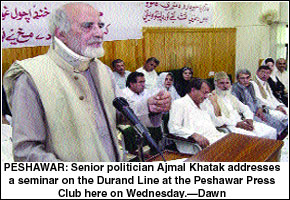 PESHAWAR, Oct 15: Politicians on Wednesday termed the Durand Line as an administrative need of the then British rulers, which had divided the Pukhtuns into four different units and was not a sacred deal between the then Afghan king and the English rulers of the subcontinent.
Speaking at a two-day conference on the Durand Line, organized by the Pukhtunkhawa Qaumi Party here at the Peshawar Press Club, the Pukhtun, Sindhi and Seraiki leaders from Sindh, Balochistan, Multan, Germany and Afghanistan underlined the unity of Pukhtuns for their well-being as a collective ethnic unit.
A delegation of the Pukhtuns Social Democratic Party, headed by Makhan Shinwari from Germany also attended the conference. Jalal Mahmood Shah, a former Sindh speaker, M. A. Bhutta, senior vice-president of Seraiki National Party and Shahsul Huda Shams of the Afghan Millat Party categorically termed the Durand Line as a legacy of the colonial rule, which needed to be removed.
Awami National Party leaders, Ajmal Khan Khattak, Ghulam Ahmed Bilour, Fareed Toofan, Zahira Afrasiab, PPP leaders Rahimdad Khan, Yawar Naseer, Shazia Tehmas Khan, NAPP leader Abdul Latif Afridi, Malik Amanullah Khan (Quetta), Shamim Qaiser Khan and some Pukhtun poets and writers were also present on the occasion.
Earlier, opening the maiden session of the conference, the PQP chief Mohammad Afzal Khan explained the importance of the conference. He said this was an administrative need of the British rulers which could not be recognized as a permanent boundary line.
Makhan Shinwari of the SDP was of the view that this division had caused irreparable losses to the Pukhtuns on both sides of the border. In Afghanistan, Pukhtuns were living with Tajiks and Uzbeks and in Pakistan they were residing along with Sindhis, Balochs and Punjabis. But, they themselves were divided into four parts, which resulted into their backwardness and abject poverty, Mr Shinwari added.
Prof Fazal-i-Rahim Khan Marwat, a teacher of Pakistan Studies at University of Peshawar, read out paper on the ‘Importance of the Durand Line’ and said this ethnic division had multiplied the miseries of Pukhtuns in Balochistan, NWFP, Fata and provincially administered tribal area (Pata).
Mr Afzal Khamosh of the Mazdoor Kisan Party said either Pukhtuns would have to establish a greater Afghanistan or they would have to defend Pakistan. He said Pukhtuns could not be united in the two separate countries.
Ms Shamim Qaiser, a district councillor from Peshawar, said that even the NWFP was being run by, at a time, an elected chief minister and a governor nominated by Islamabad. The governor, she said, was running the tribal belt.
Mr M. A. Bhutta of the SNP said before the imposition of One Unit, the Seraiki people had their own Bahawalpur assembly, but after the dismemberment of the One Unit, the then military rulers had merged Bahawalpur with Punjab. The Bahawalpur state had signed an accord with the governor-general of Pakistan and joined Pakistan after 1947, but the Seraikis were being treated as subjects of Punjab, he added.
Mr Jalal Shah of the Jeay Sindh Mahaz said Pakistan’s rulers should first recognize the separate identity of the Sindhis, Punjabis, Balochs and Pukhtuns and grant them their national rights. The nationalism was a political reality of this century, he added.