0
0

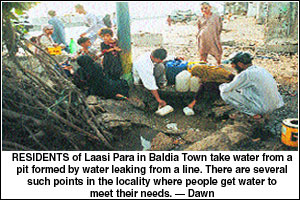 KARACHI, Oct 15: Various parts of the city on Tuesday remained in the grip of acute water shortage owing to frequent power failures at the Gharo pumping station and the diversion of Indus water to the localities hooked to the Hub dam source.
The other major causes of the persisting water shortage in many localities are maladministration in the water distribution system and manipulations by valve-men.
The localities which often either go dry or get scant supply include Mehmoodabad, Manzoor Colony, Clifton’s blocks 2, 4 and 5, Ramswami, Ranchorre Lane, Lyari’s D D Chaudhry Road, Pakistan Chowk, Shoe Market, Usmanabad, Kharadar, Mithadar, North Karachi’s sectors 5C-1, 5C-2, 5C-3, Garden East, 11C-1, 11C-3, Shadman Town, different sectors of Orangi, Baldia and Shershah.
The other localities where water supply remained suspended on Wednesday included Garden East, Garden West, Soldier Bazaar, Shikarpur Colony, Saddar, Old City Area and Cosmopolitan Society. These areas went without water as a part of the city government’s water and sanitation department’s plan of diverting Indus water to the localities hooked to the Hub dam source.
APARTMENT BUILDINGS: A large number of apartment buildings, particularly those located in Gulshan-i-Iqbal and Gulistan-i- Jauhar, often experience water shortage mainly owing to artificial water shortage created by valve-men.
Accusing valve-men of creating artificial water shortage, people residing in various apartment buildings, particularly those situated in Gulistan-i-Jauhar and Gulshan-i-Iqbal, said they had no choice but to pay monthly ‘Bhatta’ to the valve-man through the office-bearers of residents welfare associations of their respective projects for ensuring uninterrupted supply to their housing projects.
A resident of an apartment building “Billy’s Towers”, situated in Gulistan-i-Jauhar’s Block 20, having over 500 flats, told Dawn on condition of anonymity that the residents’ association paid Rs5000 each month to the valve-man concerned for operating the valve system properly, so that water to the housing project was released with pressure.
“Other than the monthly payment which is paid to the concerned valve-men, the residents’ association incur an additional financial burden on the purchase of private tankers because that water supplied through the pipeline is not adequate for meeting water requirements of such a large number of apartments,” he added.
Complaints of persisting water shortage have also been received from Malir, Bin Qasim, Landhi, Korangi and Shah Faisal towns.
A spokesman for the W&S department attributed the poor supply to the towns to the power failures occurring almost daily for the last four days at the Gharo pumping station. “Even on Wednesday there was no electricity at the Gharo pumping station from 4.40am to 3.10pm,” he added.
CLIFTON: Residents of Clifton’s block 2 complained that since they were supplied water only twice in a week, i.e. Wednesday and Saturday, for hardly 20 minutes on each day with a very low pressure, they had no choice but to purchase private tankers at exorbitant rates.
“Isn’t it injustice that on the one hand we have been spending a huge amount on the purchase of private tankers and, on the other, a good amount under the head of official water charges?” asked a perturbed resident of Clifton’s block 2.
ORANGI: Complaining of persisting water shortage in different localities of Orangi Town, the Nazim of the township’s UC-9, Ms Shehnaz Perveen, regretted that although their turn of getting the supply came after every six or seven days, the officials of the city government’s water and sanitation department often failed to implement the schedule in letter and spirit.
According to her, the worst affected localities include Orangi Town’s Ali Nagar, Nishan Haider Chowk, Pakistan Bazaar, Ghausia Baloch Colony, Makhdoom Shah Colony, Aziz Nagar, Warsia Colony and its adjacent areas.
Expressing anger over the indifferent attitude of the officials concerned, she alleged that it was almost impossible to contact the senior officials of the W&S department as “they not only avoid meeting us at their offices, but also often keep their cellular phones off”.