0
0

 KARACHI, Oct 8: Unwarranted delay in the passage of the Brain Death Law not only denies thousands of end-stage renal failure patients a chance of survival but makes more acute their plight too.
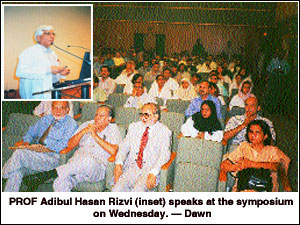
Prof Adibul Hasan Rizvi in a presentation entitled “Liver Transplantation: Promises and Problems” at the symposium called “Liver Transplantation: From Bench to Bedside” on Wednesday maintained that the estimated need for livers, coming to about 5,500 per million population annually, remains largely unmet.
While liver transplantation was said to be an optimal treatment for end-stage liver failure, Prof Rizvi regretted that not many surgical operations involving grafting were being undertaken in the country simply because of a lack of culture for organ donations.
Saying that the organs needed for grafting might come from cadavers or from living donors, the senior surgeon pointed out that Pakistan was facing a lack of expertise and inadequate infrastructure. The SIUT was, however, said to have taken all the necessary measures to start with this kind of pioneering work.
The institute was anxiously waiting for the implementation of the cadaver law, he said. “The doctors at the SIUT have started animal surgery to acquire technical expertise,” he said, stressing that the programme could only be successful when besides the cadaver legislation enough funds were made available for establishing the required infrastructure.
It was mentioned that resection of liver tumours in children and adults was being performed at the SIUT. Yet the very technology that was used in a vast majority of the countries was largely non-existent in the country, leading to high mortality rate among people suffering from liver diseases.
Dr Sina Aziz, speaking on “Liver Transplantation: Who Needs It?”, said paediatric liver transplant was a reality in many parts of the world. But the same was yet to materialize in Pakistan.
General Secretary of the Pakistan Society of Gastroenterology (PSG), Dr Zaigham Abbas, cited chronic liver disease as a major health concern, adding that the fast surge in the incidence of Hepatitis B and C was witnessed here.
Four per cent of the population was estimated to be suffering from Hepatitis C, with similar percentage of people having Hepatitis B virus. According to him an estimated pool of 12 million people infected with the two ailments was reason enough to take up the issue on an emergency basis.
Managing these patients was placing tremendous burden on the national health budget, the doctor observed. Dr Zaigham also referred to the growing vulnerability of Hepatitis B patients to cirrhosis and liver failure, leaving them with liver transplantation as the only option for survival.
He underscored the need for national guidelines to manage liver infections or diseases. With regard to live liver donation, he said while a segment of the liver could be sufficient for children the adults, however, required the entire right lobe. Liver was an organ with a capacity to regain its original size after resection or transplantation, he added.
The Vice Chancellor of Karachi University, Dr Zafar Said Saifi, was appreciative of the work undertaken at the SIUT. The chief guest stressed upon the replication of the SIUT’s programmes in other institutions of the country.
He underscored the need for maximum public awareness with major emphasis on prevention.
Dr Abdul Nasir, Hepatologist from Phoenix, Arizona, Prof Wasim Jafri, Dr Zahid Anwar Khan, Dr Haider Mehdi, Dr Saeed Hamid, Dr Faisal Siddiqui, Dr S. Mujahid Hussain, Dr Hasnain Shah, Dr Saad Niaz and Dr Nida were among the other speakers on the occasion.—APP