



 0
0

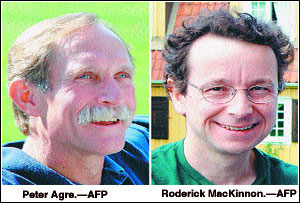 STOCKHOLM, Oct 8: US scientists Peter Agre and Roderick MacKinnon have won this year’s Nobel chemistry prize for studies of cell membranes, which have contributed to the understanding of fundamental life processes.
The Royal Swedish Academy of Sciences, which awards the prestigious prize, said on Wednesday their discoveries of how salts and water are transported in and out of human cells was of “great importance for our understanding of many diseases”.
Agre, 54, from Northfield, Minnesota, works at the Johns Hopkins University School of Medicine in Baltimore. MacKinnon, 47, grew up near Boston and works at Howard Hughes Medical institute at the Rockefeller University in New York.
“This year’s Nobel Prize in Chemistry rewards two scientists whose discoveries have clarified how salts (ions) and water are transported out of and into the cells of the body,” the Academy said.
“The discoveries have afforded us a fundamental molecular understanding of how, for example, the kidneys recover water from primary urine and how the electrical signals in our nerve cells are generated and propagated,” it said.
In 1991, Agre discovered a molecular membrane water channel. His finding ultimately revealed an entire family of water channels now called aquaporins.
“This decisive discovery opened the door to a whole series of biochemical, physiological and genetic studies of water channels,” the Academy said.
“Researchers can follow in detail a water molecule on its way through the cell membrane and understand why only water, not other small molecules or ions, can pass,” it said, adding this had enhanced medical doctors’ understanding of kidney diseases.
MacKinnon’s contribution was in the field of ion chanels, which are membrane-spanning proteins that form a pathway for the flow of inorganic ions across cell membranes.
Shaped like tiny doughnuts floating in oil, ion channels perform the dual functions of gateway and gatekeeper. The holes in the doughnut form the gateway through which the ions flow.
Ion channels control the pace of the heart, regulate hormone secretion and generate the electrical impulses underlying information transfer in the nervous system.
“Thanks to this contribution we can now ‘see’ ions flowing through channels that can be opened and closed by different cellular signals,” the Academy said.
The 10-million-crown ($1.3 million) Nobel Prize was founded in the will of Swedish industrialist Alfred Nobel, who invented dynamite. The
prize has been awarded since 1901.—Reuters



























