0
0

LAHORE, Oct 7: The Punjab government on Tuesday gave suggestions to the National Reconstruction Bureau for improving the district government system and effectively implementing the Police Order 2002.
It iterated its demand of the executive powers for local government employees for the implementation of local and special laws, and establishment of a central office in districts to manage crisis.
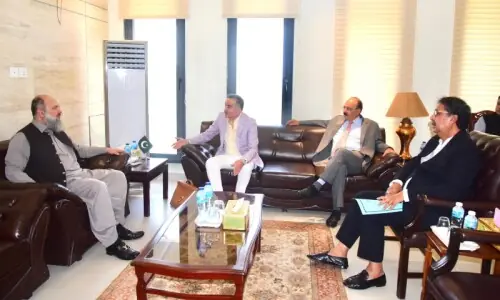
The suggestions were made during a marathon meeting between the teams of the NRB, headed by its chairman Daniyal Aziz, and the government at the Civil Secretariat. Chief Secretary Hafeez Akhtar Randhawa led the latter’s bevy.
The NRB is consulting all provinces, members of assemblies and Nazims for improving the local government system and the new police order keeping in mind the ground realities and hurdles in their implementation. It will submit information gathered in the process to the federal government for improving the local government and police systems.
The two sides agreed to remove shortcomings in the government system and the Police Order 2002 to make these more effective and result-oriented.
Officials said the chief secretary had asked for improvement in the selection of the members of the public safety commissions, and powers to penalize police officers and others found guilty of any crime or dereliction of duty.
He discussed powers of the district Nazims and their role. He demanded executive powers for the local government officials for the implementation of special and local laws, and creation of a focal post which could take decisions in emergencies.
The chief secretary said there was no harmony between the provincial and the district governments and between the district governments and the tehsil municipal administrations. He also brought to light friction between district Nazims and Naib Nazims at many places, seeking powers for the latter to create a balance between the two offices.
He mentioned difficulties being faced in the creation of the community boards at union council level, and called for a mechanism to monitor use of funds by the local governments. He said there was, at present, no system to take action against a local government found embezzling or misusing funds.
The Punjab team demanded changes in the Local Government Ordinance and the Police Order 2002.
Later, talking to reporters, Daniyal Aziz said both the sides discussed issues relating to the new police order and the local government system so as to further improve these. There was nothing adversarial, he added.
Replying to questions, he said, no new deadline had been set by the federal government for the implementation of the police order. He also ruled out any change in the police or the local government laws.
Instead of amending the laws, he stressed that the country required consequential legislation, which had been made to some extent.
He termed the magistracy “a colonial system which had to be shed.” After its abolition, regulatory functions had been changed, but officials of various departments had been enjoying regulatory powers, he said.
When asked about the mechanism of the implementation of the local and special laws, Mr Aziz said, the Nazims were already enjoying powers in this regard.
He said during the meeting many missing links were pointed out in the new government system. These links would be created to make it effective, he said.
Mr Aziz said the system would have to stay and the number of related issues, which were noticed two years ago, had reduced with time. “This system mainly lacks empowerment of the union councils, and the government will consider it because of the central position these have been occupying in the system.
NRB consultant on police reforms, Z U Khan, said the Punjab was taking a lead as far as implementation of the new police law was concerned. He said the proposed prosecution service would be independent and headed by an officer of BS-20 or 21, who would be directly responsible to parliament.
The province, he said, was facing problems in finding SPs for the investigation cells in the districts. It had appointed only five so far, he added.
Chief Secretary Hafeez Randhawa informed reporters that the local government and the police laws needed amendments. Making a point about the practical difficulties, he said, there was the issue as to who would coordinate with the non-devolved departments at the lower level.
Mr Randhawa said this area had been left unattended and, at present, there was no system to coordinate between the non-devolved departments in case of some emergency. In the previous system, deputy commissioners used to coordinate in such events, he said.
He explained that the province was not demanding magisterial powers as such, but it had been pleading for executive powers of the magistrates for the implementation of local and special laws.
Previously, Mr Randhawa said, executive magistrates used to stop some objectionable action, like selling of substandard food or encroachment, before the verdict of a court of law, giving immediate relief to the people. But, he said, there was no such arrangement in the current system. There were over 100 local and special laws, and somebody would have to be assigned the job to implement these. “We are asking the government to give the executive powers to the departments concerned,” he said.
He said Mr Aziz was informed that there should be municipal police under the district Nazims because they could not direct police in any way in the new system. He had also been informed that somebody had to be given a coordinating role to tackle emergencies of all sorts, an undefined area which must be considered,” he said.
Mr Randhawa said under the colonial policing system immense powers were given to the SHOs whereas the SPs were given the role of superintendence. Then there was a magisterial check on the working of police.
But now, he said, a new police system had been given in which there was no checks and balances. “We are asking them to empower the safety commissions to take action against police,” Mr Randhawa said.