0
0

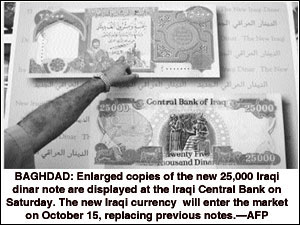 BAGHDAD, Oct 4: Iraq’s Central Bank unveiled on Saturday the country’s new currency, which will go into use October 15, and which will push banknotes bearing Saddam Hussein’s smiling face into the dustbin of history.
Ahmad Salman Mohammed, a deputy governor of the central bank, declined to say how many banknotes were printed but said there were sufficient new dinars to replace the old ones and “keep reserves for two years”.
Six new denominations — 50, 250, 1,000, 5,000 and 25,000 dinars — will replace the former five and the period to exchange the old ones will last until January 15, Mohammed said.
It will be a united currency for united Iraq, he told a news conference at the heavily guarded Central Bank of Iraq.
Mohammed did not reveal where the new banknotes were printed but said they contained the most up-to-date anti-counterfeit features to ensure that they could never be counterfeited.
Top US civil administrator Paul Bremer announced in July that the new banknotes would replace the New Iraqi Dinar in use since 1991, when UN sanctions imposed on Iraq for invading Kuwait the previous year forced Baghdad to rely on domestic firms to print money.
The so-called Swiss Dinar, which was printed in Britain, remained in circulation in northern Kurdish regions that slipped out of Saddam’s control following the 1991 Gulf War.
NICOSIA: Iraqi oil authorities are looking at establishing a national oil company to manage the industry’s operations, the Middle East Economic Survey reports in its Monday edition.
The principle idea is to establish a state-owned company, independent of the ministry of oil, with a chairman and a board of directors headed by the minister of oil, the specialist weekly says.
The funds for the company are to be derived either from a flat percentage fee on oil exports or a reimbursement of approximately one or two US dollars per barrel being produced, reflecting the cost of production.
The Cyprus-based newsletter adds: “It is understood the Coalition Provisional Administration in Baghdad is not keen on this idea since it wants to have full control and jurisdiction over the oil revenue through the Iraqi Development Fund with no money being diverted directly to any Iraqi institutions.
So far, all reconstruction work has been channeled directly by the Pentagon through the no-bid contract awarded to Halliburton Company unit Kellog, Brown and Root (KBR), MEES notes.
The survey also reports “optimisim” in Baghdad that oil output may increase in the coming weeks with the arrival of power generators for the fields and refineries and with increased security in the south.
MEES estimates indicate that current production capacity is around 1.9 million barrels per day (bpd) with approximately 1.4 million bpd from the south and 500,000 bpd from the north.
Exports of Basrah Light averaged about one million bpd in September, around 475,000 bpd went to domestic consumption and 200,000-250,000 bpd were reinjected oil in the fields after stripping away associated gas.
Continued sabotage to pipelines in the north have halted exports of Kirkuk crude, which US officials say should resume by mid-October. —AFP