0
0

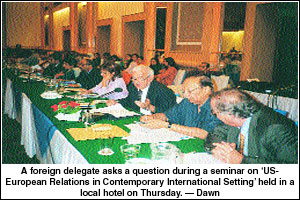 KARACHI, Sept 18: The need for resolving the Kashmir issue between India and Pakistan through peaceful means and addressing the root cause of terrorism in South Asia was emphasised by scholars from the two countries, who also suggested that there should be some security arrangement for South Asia.
The South Asian perspective was articulated by prominent Indian journalist-diplomat and peace activist Kuldip Nayar and Pakistan’s former foreign secretary Najamuddin Shaikh on the concluding day of the two-day seminar on US-European relations and their implications for the developing world.
While Mr Nayar, who has been involved in track-II diplomacy, used formulations for accusing Pakistan of harbouring terrorist elements, which were akin to the standard foreign office statement, Najamuddin Shaikh responded by saying that “when you oppress people through 700,000 troops that can only be said state terrorism, which need to be addressed.”
Mr Nayar was of the view that solution to this conflict be found bilaterally by India and Pakistan through negotiations and that the Kashmiris, who, he said, were also a party to it, be also involved in the process. Kuldip Nayar was not averse to Simla process.
When asked, as to why India was not agreeing to international monitoring of the Line of Control, Kuldip said that we did not want any intervention of the West. However, he said New Delhi was willing to allow a monitoring by the SAARC countries’ observers and forces.
He stressed the need for initiating something in this regard and maintained that people to people contacts, travel and trade would contribute towards a conducive environment in this respect.
He also asked both India and Pakistan to “bury the hatchet” and be friendly.
In his presentation on confidence building measures, Mr Nayar said the world and more specifically Asia was in serious trouble. “Country after country is being destabilized by the ‘Jihadis’ who attack at will any civil society, unmindful of the religious beliefs of the victims.”
Remnants of the Talibans were not letting the Karzai regime stabilize in Afghanistan, he claimed, maintaining that a disturbed Afghanistan had always affected peace and stability of the adjoining countries in the Central and South Asia and now extending to the Central Eurasia.
A crucial question, from the stand point of security environment, was how long the US and the NATO forces would remain in Afghanistan and for how long Russia and China could tolerate their presence in their strategic backyards, he said.
Instability in the region was also causing growth of ‘Islamist fundamentalisms’ in Xinjiang and Uighur autonomous regions of China, he said, refering to some media reports that over 10,000 Uighurs were presently undergoing military-cum-religious training in Pakistan and Afghanistan.
But his contention was challenged by Dr Azmat Hayat Khan who said there was no proof of such allegations.
“Kashmir issue”, he said, “has led to a perpetual state of hostility with Pakistan that continues to abet terrorism as an instrument of its state policies”.
He called for restoring the primacy of the United Nations as the global multilateral forum, which embodied the collective will of its member states and the rule of law.
He called for an Asian security order comprising primarily all the states of Asia, including Russia, China and others. The trilateral consultations at the Foreign Ministers’ level between Russia, China and India provided a basis for such an Asian forum, he said.
He opined that it (forum) would reflect Asian values such as consensus, conciliation and a peaceful resolution of all disputes.
Mr Nayar was of the view that the US had taken full advantage of the events to build a chain of military bases in Pakistan, Afghanistan, Gulf countries, and the Central Asian Republics, and said that Iraq and the rest of Asia did not need more troops.
He urged the US and Europe to have a Marshal Plan for South Asia and engage in economic development of the region.
About the recent visit of Israeli prime minister to India, he said that this was done on behalf of the Indian ruling party which represented fundamentalist trends.
“Since we are victims of acts of terrorism we tend to look for allies for fighting terrorism”, he argued.
He said that Palestine be recognized as an independent state and that Israel must go back to the original position.
Expressing his views, Najamuddin Sheikh called for the resolution of the Kashmir issue in accordance with the UN Security Council resolutions, keeping in view the aspirations of the Kashmiri people.
He emphasized the need for negotiations on nuclear and conventional arsenals. While calling for taking measures for nuclear risk-reduction in the region, he said that the US’s own position on nuclear weapons had undergone a change that put its moral authority in question.
Referring to the problem of terrorism in the region, Mr Shaikh said it started long time ago and must be addressed peacefully and not through force.
Agreeing to Mr Nayar’s idea of a Marshall Plan for the region, where there was poverty and despair, he said that “if there was a Marshall Plan you would be fighting terrorism where it needs to be addressed.”