0
0

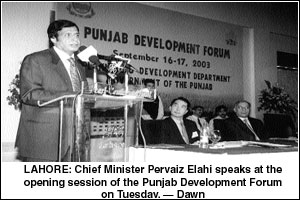 LAHORE, Sept 16: Chief Minister Pervaiz Elahi has emphasized the need for close cooperation between the government, private sector and development agencies for improving the quality of life of the poor.
“Our government is focussing on improving the quality of life of common people of the Punjab. It is my conviction that without undertaking reforms, we cannot improve the social and economic conditions of our people. Our commitment to reforms is strong and unshakeable,” he said while speaking at the opening session of the two-day Punjab Development Forum (PDF) here on Tuesday.
The chief minister gave an overview of the reforms undertaken by his government in areas like education, healthcare, access to justice, agriculture and industry.
He said the government reform agenda depended on finding budgetary resources to finance its initiatives on a sustainable basis. “There is a pressing need to enhance the fiscal space available with the Punjab government. The additional fiscal space will come not only from restructuring our expenditure but also from strengthening our revenues and tax base.” He said his government planned to undertake a study to assess the impact of subsidies on poverty.
However, he insisted, in modern times the development needs could not be left solely to the government. He said partnership between government, private and development agencies was vital for the attainment of the desired goal of sustained development.
Pervaiz Elahi said good governance “remains my guiding light”, adding the provincial legislature was actively involved in legislation. He said the government was following a merit-driven recruitment policy and had rejected the culture of revenge-based politics. “Thankfully, to date, my administration remains corruption free,” he claimed.
He said his government continued to help the functioning of the local governments by ensuring an adequate flow of funds and providing capacity and personnel support. “We believe the new local government system would give new hope to the poorest in society.”
FINANCE MINISTER: Speaking on the occasion, Federal Finance Minister Shaukat Aziz said the economic growth was an important factor in reducing poverty and releasing sources for human development. However, he said, a weak social profile was detrimental to growth. He warned that economic growth did not guarantee human development. But human development certainly leads to sustainable growth.
He said: “Well functioning civil institutions, access to justice, secure individual and property rights, and broad-based health and educational services are vital to raising the living standards. Pakistan’s long-term sustainable growth and poverty prospects are critically contingent upon investment in human capital as better human capital equipped with education in science and technology and information technology can be instrumental in increase agriculture productivity, enhancing industrial output and increasing exportable surplus.”
He appreciated the Punjab government was undertaking reforms in key areas for the development of human capital of the province. He advised the provincial administration to pursue an integrated approach to improve quality and access in five key areas: literacy and primary education, primary healthcare, economic empowerment, improving governance and building investors’ confidence.
Mr Aziz said the government was not complacent with its economic achievements. It was conscious of the challenges it was faced with. He said the government needed to escalate the growth rate to reduce poverty. Further, he said, larger resources needed to be spent on human development. “To this end, we need to create additional fiscal space and mobilize resources both in the public and private sectors.”
He said the bottlenecks in achieving full potential of the economy posed by an inadequate stock of infrastructure must be removed. He said the investment in the private sector also remained a challenge for the government. He said though there had been significant improvement in investment levels, both domestic and foreign, a much higher effort was needed to achieve economic development and higher growth. He said the government was fast vacating the space for the private sector that must be occupied.
“These challenges clearly underscore the need for continued cooperation with our development partners. We are confident that together we can create an environment where people have access to basic human needs and decent work opportunities,” he said.
Concluding his speech, the minister said the “even bigger challenge we face is the continuity and consistency in reform process”. “We are endeavouring to stay on course and need to guard against reversals, slippages and loss of momentum.”
Earlier, Punjab Planning and Development Board chairman Humayun Farshori welcomed the delegates to the forum.