0
0

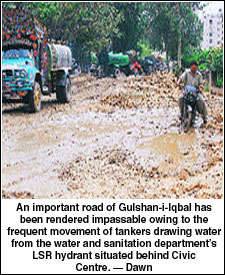 KARACHI, Sept 14: At least five main roads and a number of streets, situated in the vicinity of Rangers-manned water and sanitation department’s hydrants, have been ruined owing to frequent movement of water tankers, causing damage to vehicles and problems for the passersby.
In addition, scores of other roads and streets, situated in the vicinity of hydrants, belonging to water department as well as private hydrants, are in a dilapidated condition, troubling motorists and damaging their vehicles.
The deep craters and potholes, which have developed on these roads, may cause accidents.
The roads which have been devastated due to frequent movement of tankers, operating to and from W&S department hydrants, being operated by Rangers, include Dadabhoy Nauroji Road, Capt Fareed Bukhari Shaheed Road, Sindhi Muslim Housing Society’s main roundabout, Gulshan-i-Iqbal’s Mashrique Shopping Centre’s road leading to Gulshan-i-Iqbal’s Block 14, a portion of main Stadium Road near Civic Centre, North Nazimabad’s main road that connects Sakhi Hassan roundabout with Federal B Area.
The other roads which had developed deep craters and potholes owing to frequent movement of tankers drawing water from such hydrants include a portion of Khalid Bin Waleed Road, Sharea Quaideen, Kashmir Road, New M A Jinnah Road, besides several internal streets of Muslimabad, Catholic Colony and Federal B Area’s Block 13 and the road that leads to Gulberg roundabout from water pump roundabout.
As far as Gulshan-i-Iqbal’s Block 14 road is concerned which had been rendered impassable by hundreds of tankers drawing water from the W&S department’s LSR Hydrant, situated behind the Civic Centre, is in such a bad shape that in case of emergency, drivers of ambulance often decline to enter the locality.
The people residing in various apartment buildings of Gulshan- i-Iqbal’s Block 14 as well as those visiting the former DC (East) office, which currently houses the offices of the city government’s Revenue Department, have no choice but to walk on the ruined road as its footpath is heavily encroached upon.
Two other hydrants, which are situated near North Nazimabad’s Sakhi Hassan roundabout and Federal B Area’s water pump roundabout, have, indirectly, devastated one service and a main road of North Nazimabad which leads to FB Area and another service road of FB Area’s Block 13, besides creating hindrance in the smooth flow of traffic in and around both the roundabouts.
Despite the City Nazim Niamatullah Khan’s repeated orders regarding closure of both the hydrants, belonging to the city government’s W&S department, the Rangers personnel managing the hydrants have not complied with the directives.
Similarly, a large number of other roads, situated in the periphery of over 115 private hydrants, have also been extensively damaged, besides most of them are reportedly responsible for creating water shortage in the localities where they exist, as they have been allegedly stealing water from the water and sanitation department’s pipelines.
An official of the W&S department said that the department had recently detected two illegal connections created by a private hydrant, namely Mashalla hydrant, unlawfully taken from two different pipelines of 66 and 48 inch dia. Since both the pipelines were the main source of supplying water to Orangi and Baldia, a substantial quantity of water was being drawn by the hydrant from these two pipelines and thus was creating artificial water shortage in both the townships.
Another hydrant, set up on Plot Nos LS-21/22 (ST-7), Sector 48-B, Korangi No 2 (Union Council-4), had been doing roaring business of water by drawing water from locality’s pipeline, he said, adding, that round-the-clock movement of tankers fetching water from a hydrant situated near Yasinabad bridge, had caused extensive damage to the nearby roads.
These water tankers are not only causing damage to roads, owing to their leaking nozzles, but often result in accidents because of rash and speedy driving.
ACCIDENTS: Insiders told Dawn that the root cause of accidents involving tankers was the fact that some of the tanker drivers aredrug addicts, and under the influence of drugs they seldom care about the vehicles’ maximum speed limit which is 40mph, prominently written on almost every water tanker.
A heavy fleet of tankers, including those having capacity of 10,000 to 15,000 gallons, most of the time keep on shuttling between the hydrants and the water-starved localities via various city roads, making these slippery owing to their leaking nozzles.
Over 2,000 tankers which draw water from 30 filling points of two different hydrants of Muslimabad, on the one hand, are fast devastating these roads and, on the other, are the main source of accidents on some of busy roads, particularly those situated in the vicinity of the hydrants. A number of accidents, involving tankers, have already occurred on Dadabhoy Nauroji Road and at two busy traffic intersections — Sharea Quaideen-Khalid Bin Waleed Road and Sharea Quaideen-Tariq Road intersections.
Tankers getting water from Muslimabad hydrants, have increased manifold during the last two years as now there is no restriction on the water capacity of the tankers. Earlier, only those tankers with a capacity of 1,200 gallons of water, were allowed to get water from these hydrants. These tankers have become a source of nuisance for the residents of Muslimabad and the nearby Catholic Colony as whenever there is long queue of tankers at the hydrants’ filling points, the drivers of tankers usually park their vehicles not only on the main Dadabhoy Nauroji Road but also all along the boundary walls of the bungalows in both the residential areas.
Residents of both the localities often complain that conductors and drivers of tankers, who usually remain seated on the tankers’ roof tops, not only shout but also use abusive language against each other, thus encroaching upon their rights of privacy.
It has also been observed that drivers of tankers often indulge in rash driving while proceeding towards Muslimabad hydrant from Dadabhoy Nauroji Road and from the nearby Aisha Aziz park, despite the fact that a number of schools are situated in the vicinity and school vans keep on picking and dropping students at their schools.
On the one hand, tankers drivers are in the habit of negotiating sharp turns from the near Society Office roundabout and another roundabout, situated neat Aisha Aziz Park and, on the other, drivers of school vans, in their bid to take a short cut usually speedily bring their vehicles on the Dadabhoy Nauroji Road’s other track without realising that fast-driven tankers coming from the opposite side of the road might hit their vehicles.
NISHTAR ROAD: A major portion of recently-built Nishtar Road (from Lasbella to Tin Hatti traffic intersections) which has remained impassable for a decade and was reconstructed only last year, has once again been exposed to devastation following re-opening of hydrants, situated on the nearby Lyari River bank.
A large number of tankers which used to draw water from the nearby hydrants had not only ruined the said portion of the road but had also created deep craters in the adjoining Jehangir and PIB Colony Road.
Reportedly, in response to the alleged involvement of some police officers in re-opening of hydrants in the area, the city Nazim, in a strongly worded letter to the capital city police officer (CCPO), had asked him to ensure the closure of hydrants, because such an act amounts to challenging the writ of the city government.
People residing in the localities near the hydrants, off and on, demand shifting of these hydrants to some far flung areas as they suspect that the main cause of water shortage in their localities is rooted in hydrants. In support of their contention, they argue that it was beyond their comprehension that how come these hydrants get regular supply whereas their localities often face water shortage when the pipelines supplying water to their localities and the hydrants are the same.