



 0
0

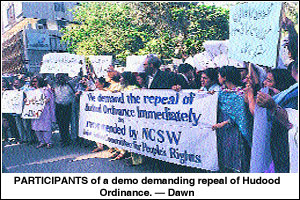 KARACHI, Sept 11: A demonstration was organized by the Joint Action Committee for People’s Rights (JACPR) for the repeal of Hudood Ordinance and certain other laws regarded as discriminatory against women, minorities and marginalized sections of the society.
Addressing the participants of the demonstration, held in front of the Karachi Press Club on Thursday, speakers claimed that the Hudood Ordinance was being misused by vested interests, In this regard, they observed that the number of women prisoners had increased manifold since the promulgation of the ordinance.
The speakers demanded an immediate repeal of the ordinances and other discriminatory laws as well as an unconditional release of all women prisoners convicted/arrested under them.
They spoke of the agonies and ordeals a woman faces after being accused of violating Hudood Ordinance and pointed out that such women could never regain their grace, dignity and prestige in the society even if they are exonerated from the charge.
They regretted that political parties, including the PPP, PML and Muttahida, did support women’s rights groups and also kept criticizing the Hudood Ordinance and discriminatory laws, but none of them came out with some practical measures that could lead to their abolishment.
The speakers pointed out that even a resolution calling for the repeal of Hudood Ordinance could not be moved in the parliament or any of the provincial assemblies. To the contrary, they added, the NWFP Assembly had adopted a resolution in favour of it.
They alleged that the women belonging to lower class were being targeted by the vested interests who were out to exploit the laws.
The speakers vowed to mobilize masses and put up strong resistance against the ordinance and the laws in order to “prevent spread of fanaticism”.
They were of the view that the laws had been promulgated by a military dictator who didn’t have public support. He, they alleged, had misguided people and misused religion to perpetuate his illegal rule.
They observed that various commissions and committees, set up by successive governments, had found the ordinance and laws ill-intentioned, badly conceived and badly drafted.
Two religious scholars, who are members of the sitting review committee of the National Commission on Status of Women, have also expressed their reservations against the laws and endorsed the ideas of certain other eminent religious scholars that the laws needed to be amended, they said.




























