



 0
0

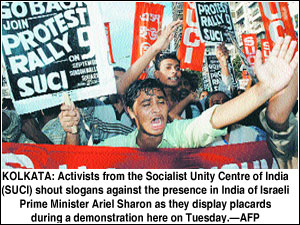 NEW DELHI, Sept 9: Amid nationwide protests against the visit to India by Israeli Prime Minister Ariel Sharon, the two countries on Tuesday renewed their resolve to build closer ties, a move that has raised concern in Pakistan.
The two countries also discussed cooperation in fight against terrorism, but not before a senior Israeli minister revealed that Pakistan was a major issue they had to tackle.
“We are providing India with military technology and exchanging knowledge and information,” Israel’s Deputy Prime Minister Joseph Lapid said at a function where the two sides discussed terrorism.
“We are not directly helping India in its relations with Pakistan, but I am sure we are strengthening your ability to deal with the problem,” Mr Lapid said.
Not content with naming Pakistan as an issue, Mr Lapid went on to target Iran, saying Iran should not be allowed to possess nuclear weapons. The international community should make efforts in preventing Tehran from acquiring nuclear power, he added.
Such diplomatic indiscretions or possibly even well-aimed leaks were not the staple at the banquet Prime Minister Atal Behari Vajpayee hosted for Mr Sharon.
Mr Vajpayee welcoming his rightwing counterpart spoke of the joint need to target global terrorism but refrained from naming names.
“It is a menace that particularly targets democratic societies which have to fashion a global and comprehensive response to tackle it,” Mr Vajpayee said.
Observing that India was today engaged in a determined struggle to defeat terrorism against it, he said New Delhi was also bringing international pressure to bear on those who support it.
At the same time India was also engaged in the process of improving relations with all its neighbours, Mr Vajpayee said.
“West Asia and Gulf region are a part of our extended neighbourhood with which we have long-standing cultural and civilisational links. We would very much like to see an end to violence and restoration of peace in these troubled lands,” he said.
Observing that common experience of the two countries was the menace of terrorism, he said: “Bilaterally and on the international plane we are contributing to the global fight against terrorism.”
Mr Vajpayee said relations between India and Israel were ‘rooted in antiquity’.
“At the same time, we are both young nations with democratic values, seeking economic progress by tapping the creative genius of our people,” he said.
Referring to the wide-ranging talks he had with Mr Sharon, he said they discussed a number of ‘new ideas to strengthen our bridges of friendship by more fully exploiting our comparative advantages.
“I have no doubt that your visit and our discussions will be a catalyst for faster movement in the right direction,” he said.
“Our lands have supported the birth of great and ancient religions and civilisations. Jewish communities in India have, over the centuries, painted rich colours into the mosaic of Indian society,” he said.
“India is one of Israel’s strongest trade partners in Asia today. Our scientists and scholars are together exploring the frontiers of knowledge in cutting edge area,” he said.
On defence cooperation, he said, it rested on a foundation of mutual understanding of security concern. “Our people-to-people interaction has been enriched through tourism, student exchanges and cultural contacts. All these strands are tied together by a political understanding between us,” he added.
Thousands of protestors, coping with high humidity and a blazing sun, differed with Mr Vajpayee’s enthusiasm.
“Hitler Sharon go back,” read one of the placards in the throng. There were at least two large demonstrations in New Delhi and several more across the country. India’s three main communist parties led a demonstration near Mr Sharon’s hotel. The Imam of Delhi’s Jama Masjid, Syed Bukhari led another thousand or two through the busy Connaught Place market. Police arrested a few when they tried to cross the barriers.
There were long traffic snarls and endless delays as a long stretch of road on the arterial Ring Road was made totally out of bounds for vehicles during the peak morning hours when Prime Minister Aerial Sharon paid homage at Mahatma Gandhi’s memorial, Rajghat.
Mr Sharon will be in Mumbai on Thursday. Police there were keeping the details of his tour a close secret.
ISRAELI HELP: Israel on Tuesday offered India help in training personnel and providing material for its fight against “terrorism”, the Press Trust of India (PTI) said, adds AFP.
“We can train and teach and supply materials we have developed in fighting terrorism. We have developed a very advanced technology,” Israeli Deputy Prime Minister Joseph Lapid told reporters, PTI said.
Mr Lapid said both India and Israel had “mutual problems, like terrorism” and the two friendly countries could aid each other.
Both faced attacks from outside and also by “fanatic” Muslims who want to destroy civilisation, he said.
“In Israel we have a great deal of experience (in fighting terrorism). So have you,” Mr Lapid said.
The Israeli deputy PM supported the idea of opening a training institute in India with Israel for combating terrorism.
DEFENCE DEALS: Mr Sharon’s visit is expected to advance defence deals, including the sale of a more than $1 billion Israeli airborne early warning radar system. The three Phalcon radars would put large parts of Pakistan under Indian surveillance, adds Reuters.
Israeli officials accompanying Mr Sharon said they did not expect the Phalcon deal to be signed during the four-day visit, but hoped it would be finalized in the next two weeks.
India also wants to buy the $2.5 billion Arrow anti-ballistic missile system from Israel, but has yet to win US approval.





























