0
0

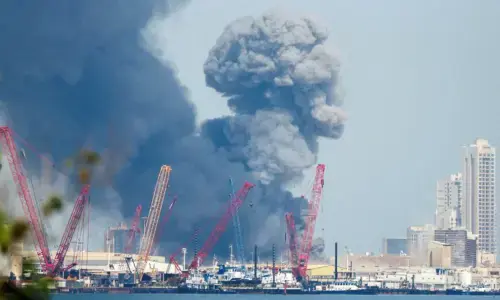
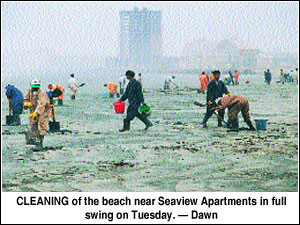 KARACHI, Sept 9: Holding that the oil spill from Tasman Spirit has damaged, or put at risk, the tropical marine ecosystem, fisheries, recreational amenities and human life along the coast of Karachi, an official committee has suggested long-term damage assessment and restoration programmes.
The committee comprising local experts was set up by the Sindh Environmental Protection Agency (SEPA), under the directives of the federal government.
Sources say the committee has completed its preliminary assessment of the situation and a formal report will be presented to the government shortly.
The report says that the extent of the damage should be determined through a methodical investigation with funds from the party responsible for the oil pollution and subsequent damages.
The committee has suggested a restoration programme with assistance of the United Nations Environment Programme, the United Nations Development Programme, SEPA and IUCN Pakistan.
The report also suggests restocking of fisheries, supply of additional food resources for predators and additional resources for fishermen.
The report stresses the need for a “Natural Resource Damage Assessment” as the studies conducted by various groups in Karachi provide valid but limited information.
According to an estimate Tasman flushed out about 30000 tonnes of crude oil. The report says that a significant quantity of oil was spilt when the stranded ship broke on August 13, and by August 18 approximately 27000 tonnes of oil had been lost into the sea.
The report maintains that the coastal environment in which the spill occurred is a rich and diverse tropical marine/estuarine ecosystem. It includes extensive mangrove forests (dominated by Avicenia marina), habitat for green and Olive Ridley turtles, dolphins, porpoises, and beaked whales, and several species of lizards and sea snakes.
About 200 species of fish are known to exist in the region, many of which are important for artisanal and commercial fisheries and are important components of the marine food web. Also, there are many species of crustaceans including shrimp, crab and lobster.
The Clifton beach, a popular recreational spot, extends from the KPT area to the DHA including an extensive reclaimed area to the west covering a total stretch of about 16 kms. To the west of the grounding site are turtle-nesting sites along Hawkes Bay and Sandspit.
Within the port of Karachi are salt ponds, mangrove forests and an artisanal harbour mainly for shrimp fishing, shipyard facilities, oil terminals, Pakistan Navy installations and seawater intake, all potentially sensitive to oil contamination.
Inspection and investigations have revealed that the air was polluted immediately after the major spill on the August 13 and 18 due the evaporated component of the crude oil. According to the chemical properties of the crude oil, approximately 11000 tonnes of volatile organic compounds entered the air after the spillage.
The pungent odour was reported to be perceptible at a distance of one km from the beach area. The residents of Shireen Jinnah Colony, Seaview and Clifton as well as workers and picnickers were exposed to 40 to 170 ppm of volatile organic compounds for at least 15 to 20 days.
Doctors at the medical camps set up to respond to the spill-related health complaints reported a high incidence of respiratory problems among the residents, suffering from asthma and irritation of eyes and skin. One of the medical camps established at the site is reported to have provided treatment to 250 persons who reported ailments attributed to petroleum carbon exposure.
The report records that the affected area covers about 40 sqkm where the seawater was found extensively hydrocarbon-contaminated.
The oil content of the water at the open sea was 1.35 mg/litre and varied from 3.95 mg/litre in the Fish Harbour Channel, to 5.15 mg/litre at the point opposite Lighthouse and 10.11 mg/litre at a point near Tasman Spirit.
The bottom sediment at the open sea was found on August 19 to contain 51.6 mg/kg and varied from 195 mg/kg in the Fish Harbour Channel, to 382 mg/litre at the point opposite Lighthouse and 968 mg/litre at the point near Tasman Spirit.
About the oil content of the sediment at the bottom of the sea the preliminary report says that the bottom of the sea over 40 km2 of the affected area is covered with oil residue largely dispersed by the high swell of the sea during 48 hours following the major spill and the next two days when dispersant was used.