0
0

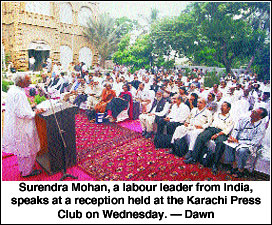 KARACHI, Sept 3: Labour leaders from South Asian countries have highlighted the role of workers’ movement for peace and democracy which they identified as common concern of the South Asian countries.
They were speaking at the reception at Karachi Press Club on Wednesday. They described the ‘Karachi Declaration’, adopted in their two-day peace conference, as a milestone in strengthening peace and promoting cooperation among the peoples of this region.
Eminent Labour leader and a former member of the Indian Parliament Surendra Mohan, who headed the Indian delegation, highlighted the salient features of the declaration and said the people and governments in the region must press for the maintenance of peace and reduction in tensions of all kinds. They should also work for fostering a friendly atmosphere conducive to good neighbourly relations.
He particularly referred to the aspirations of the people of Pakistan and India who, he said, wanted peace and friendly ties between the two countries and their people. He said that the people wanted a settlement of all outstanding disputes through bilateral and comprehensive political dialogues.
Mr Mohan recalled that the peace conference had impressed upon all countries of the regional to initiate a process of demilitarization and denuclearization besides stressing on the elimination of existing weapons of mass destruction and a halt to the arms race.
He called for mobilization of workers against hatred, prejudices and divisions based on ethnicity, race, caste, religion, etc.
Mr Thambiyan Mahasivam, a prominent leader of teachers associations in Sri Lanka, described the World Trade Organization as ‘a form of recolonization through economic warfare’ and said that its aim was to promote multinationals. He urged the labour movement to build alliances with all progressive social forces to save natural resources from exploitation.
Ms Mashuda Khatun Shefai of Bangladesh said that boundaries could keep people separate but people could not be divided. She said despite the Partition of the subcontinent and, later, emergence of Bangladesh, people of the entire subcontinent felt close and related to each other.
She also referred to the camps in her country where some people lived and did not reconcile with the situation. She said that proper education and employment opportunities had been provided to them and several development projects had been initiated there.
She pointed out that despite pursuing the same goal, these people still indulge in confrontation with each other on sectarian basis during the month of Moharram which ultimately harmed peace. To contain sectarian hatred, she added, a campaign for secular culture should be launched in the whole region.
Ms Mashuda also spoke high of the late Akhtar Hameed Khan for his contribution to the rural development in Bangladesh and said that people still kept him in high esteem for his services to the masses.
Earlier, President of the PFUJ Ahfazur Rehman, Secretary General C. R. Shamsi, Chairman of the APNEC Abdul Hameed Chaapra, and President of Karachi Press Club Sabihuddin Ghausi welcomed the guests.
The Secretary of KPC, Khurshid Abbasi, compered the programme.
The delegates to the conference also visited Power House and met KESC workers.