



 0
0

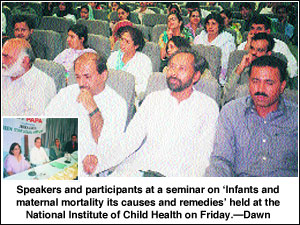 KARACHI, July 25: Speakers at a seminar on Thursday opined that through creating awareness regarding family planning and improved reproductive health services, the infant and maternal mortality rate in the country, which were among the highest in the world, could be brought down, considerably.
They were speaking at the seminar on “Infant and maternal mortality, its causes and remedies” organized, jointly by the National Institute of Child Health, Population Activities and Planing Assistance and the Green Star Marketing, at the NICH auditorium.
They stressed that awareness regarding reproductive health, in particular, and health and hygiene etc, in general, be spread among the people, particularly in the rural areas, where majority of them lived.
They said over 80 per cent of the deliveries were carried out at homes, some of which were conducted by the fully-trained traditional midwives — locally known as ‘daies’.
Sindh Population Welfare Minister Imtiaz A Shaikh, putting stress on the seriousness of infant and maternal mortality issue observed it was a part of the greater issue of unchecked population growth ratio, which, he said, needed to be brought down to a desirable level of around 1.9 per cent from the present ratio of over 2 per cent.
He said that the international donors, like the United Nations Population Fund (UNFPA), were being approached to apprise them of the need of funding more population planning programmes in the province, as was being done in other areas of the country.
He urged the NGOs, CBOs and other civil society organizations to join hands to solve the issue, which he said was very important and could not be handled by the government alone. He also urged the government sector service providers and hospitals to improve the quality of services they were providing, with better and efficient management.
Stressing better management of government facilities, he said road construction might need funds, but garbage removal from the city did not require any additional funding and only efficient management of available resources was required, similarly government hospitals could also be improved through better management, he added.
Other speakers on the occasion informed that the risk factors for infant and maternal mortality included the high-risk age group of pregnant women (below 18 and above 35 years); spacing between two pregnancies (less than 24 months). Other major causes were bleeding, heamerrouage, blood pressure etc, which could be controlled through provision of better health care facilities. They said that between 25,000 and 30,000 women in the country died due to birth-related ailments, annually.
They said that every eight minutes a child was born in the country and at an average, a woman gave birth to four plus children, adding that only around 31 per cent of the couples used the contraceptives. They said that breast feeding ratio in the country was around 9 per cent, which was the lowest in the region, with Bangladesh having 13 per cent; India 10 per cent and Nepal having 18 per cent.
They said with improved ratio of breast feeding, supplementary feeding and through giving vitamin A supplements, the death ratio among children, up to the age of five years, could be brought down by around 40 per cent.
Sadiqua N Jafarey, Afroze Ramzan, Dur Mohammad Baloch, Kamran Mashhadi, Waseem Ahmad and others also spoke at the seminar that began nearly an hour and a half behind its schedule, and the speakers were asked to cut short their speeches that were punctuated with important scientific information and data, so that the seminar could end on time.





























