



 0
0

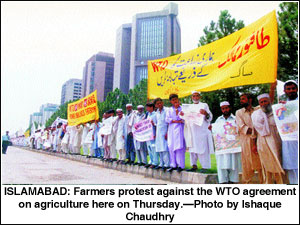 ISLAMABAD, July 24: Hundreds of farmers from all over the country staged a protest demonstration here on Thursday to express their apprehensions on the World Trade Organization (WTO)’s agreement on agriculture.
Lined up along the road at China Chowk, around 500 farmers with as many as half of them from the NWFP waved banners and placards inscribed with slogans like “WTO — an agenda of the multinationals — and why our livelihood be discussed in Geneva, etc.”
The farmers also chanted anti-WTO slogans to vent their anger. The farmers had a fair idea of what could be the possible implications of WTO for the agriculture sector of a poor country like Pakistan. “The developed countries are tying our hands but giving incentives to their own farmers,” said an elderly man from a remote area of the NWFP.
Organized by the Sustainable Agriculture Action Group, the protest demonstration was attended by members of other NGOs as well. Representatives from various farmer groups, like Kisan Bachao Tehrik (Sargodha), Pakistan Kisan Ittihad Tehrik and a few others, spoke to the media on the occasion.
They called for a thorough debate on the WTO in the parliament before finalizing the country’s position on it for the 5th Cancun Ministerial. The ministerial, a process of WTO agriculture negotiations, will be held from September 10 to 14 in Mexico. The farmers’ leaders termed the WTO a cleverly-designed tactic of the developed world to enslave the developing countries.
Some of the farmers said that even atom bomb carried no worth if agriculture sector, the backbone of the economy and a source of food security, was given in the foreign hands. They demanded consultations with all the stakeholders on the contentious issues in WTO.
Samina Omar Asghar Khan, while talking to Dawn on the occasion, said WTO was an agreement of huge importance which would have profound impact on the agriculture sector in particular. She said the maximum trade liberalization in 2005 would bring serious challenges for the country. She said the government should work out a strategy to safeguard the interests of its farmers.
She criticized the international financial institutions for pressurising the developing countries to withdraw subsidies from their farmers despite the fact that the developed countries were pouring huge subsidies in their agriculture sector, creating an imbalance of opportunities. She termed the attendance in the demonstration quite impressive.—Junaid Bahadur




























