0
0

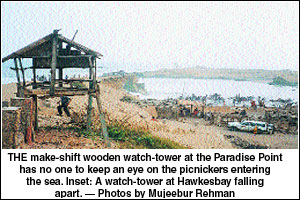 KARACHI, July 14: Over 50,000 picnickers visit the 22-kilometre-long stretch of the coastline from Sandspit to Nelam Point on holidays during the summer season.
Only 46 lifeguards of the Emergency Response Centre Hawkesbay of the fire brigade department remain alert to meet any eventuality. And the Clifton beach, which attracts a huge number of visitors, largely remains without lifeguards.
A proposal for a Hawkesbay-style rescue centre for the Clifton beach had been under consideration but could not materialize, said Kazim Ali, chief fire officer (CFO) of the fire-brigade department.
He added that from June 1 to September 15, lifeguards of the Pakistan Navy were posted at the coastline only on Saturdays and Sundays.
Zafar Khan, in charge of the Emergency Response Centre, said that in the absence of even the basic equipment— life-jackets, lifeline, binoculars, under-water breathing apparatus, water boat, communication system, watch towers etc— the lifeguards put their lives at risk every time they went into the sea
Earlier, the Emergency Response Centre had Rs10,00,000 budgetary allocation for equipment, which was later reduced to 500,000. An official said that with the lapse of the budget on June 30, all hopes for utilising the allocation for the purchase of basic equipment had vanished.
The CFO said that to make matters worse, section 144— prohibiting people from going into the water— could not be imposed for more than a week by the City Nazim under the new setup.
He added that though the Sindh government was approached, the matter still remained to be resolved.
An official said that people did not obey the restrictions imposed in the past and drownings in the monsoon season had now become a routine.
“Whenever we try to stop picnickers from going into the rough waters, they misbehave with us and question our authority, and police do not corporate with us at all in controlling the public,” said Mr Zafar
Referring to a recent incident of drowning at the Hawkesbay beach, a lifeguard said: “We told them not to go into deep waters but they snubbed us. Later, we rescued two of them who had been swept away by strong waves.”
Mr Zafar said that people often came intoxicated, or indulged in drinking at the beach, and went into the waters in the same condition.
The CFO said that before 1997 the Emergency Response Centre had six lifeguards working under the health department. In 1998, when the defunct KMC took control, five of them had attained the age of retirement. The fire department hired 30 lifeguards on contract, as there was a ban on appointment at that time. Their salaries were adjusted against vacant posts of firemen.
“Thus we are short of about 30 firemen yet to be appointed,” the CFO said adding that the 30 lifeguards were hired out of 150 candidates from the coastal areas, and being residents of the locality they were well-trained swimmers.
Following the formation of the city government on August 2000, 15 life-guards of the defunct Karachi Development Authority were brought under the working of the fire department, thus making a total of 46 lifeguards, the CFO said
“They are supposed to stop people from going into deep waters, act in emergency and save life through mouth to mouth resuscitation, use watch-towers to oversee a wider portion of the sea. But we neither have proper watch towers, nor any other equipment for the purpose.
The Emergency Response Centre is the only first-aid facility of its kind along the 22-kilometre-long stretch.
The centre has six beds with oxygen cylinders. It has some basic medicines for blue-bottle bites.
To shift serious patients to hospital the centre has a single ambulance which needs urgent repair. As far as Edhi Foundation is concerned it has no divers or lifeguards of its own.
Chief volunteer of Edhi Foundation Karachi, Rizwan Edhi, told Dawn that due to the ever-increasing cost of other relief services the Foundation was facing difficulty hiring full-time divers. “As far as the ambulances service is concerned we always rush to the spot after receiving reports of drownings,” he added.
Mohammad Usman, 45, has been working at the centre for the past fifteen years as a lifeguard. “I don’t understand why people go into the rough sea when they even don’t known how to swim,” he said.
According to the data compiled by the emergency centre, in 1998 four persons drowned at the stretch, in 1999 17 people lost their lives, in 2000 nine persons and in 2001 six persons; no person was reported drowned in 2002.
The CFO, who also heads the emergency response centre, has urged multinational concerns and philanthropists to help the fire department by developing watch towers at the beaches and donating the necessary diving equipment.