0
0

 PARIS, July 4: Unesco has inscribed 24 new sites on its World Heritage List, including Afghanistan’s Bamiyan valley, and, for the first time, sites in Gambia, Kazakhstan, Mongolia and Sudan, the UN body said on Thursday.
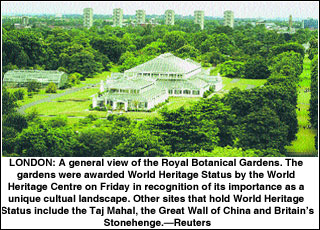
Among other sites added to the list are Britain’s Kew Botanic Gardens, three parallel rivers in China’s Yunnan area, the Rock shelters of Bhimbetka, India, Takht-i Soleyman, Iran, Ashur (Qala’at at Sherqat), Iraq.
The list now includes 754 sites of “outstanding universal value”, including 149 natural, 582 cultural and 23 mixed sites.
Adding Bamiyan to the list, Unesco said the site “symbolizes the hope of the international community that extreme acts of intolerance, such as the deliberate destruction of the Buddhas, are never repeated again”.
Ravaged by 23 years of conflict, Afghanistan’s archeological sites, particularly Bamiyan, have been badly hit by looters who have fuelled a rampant illegal trade in valuable artefacts.
The area around James Island in Gambia, West Africa, was inscribed because of its importance in the history of relations between Africa and Europe, particularly “its relation to the beginning and the abolition of the slave trade”, Unesco said.
Kazakhstan’s 14th-century mausoleum of Khoja Ahmed Yasawi was also added, described as “one of the largest and best-preserved constructions of the Timurid period”.
The mausoleum shows how Persian builders experimented with architectural methods that were later used in the Timurid empire’s legendary capital, Samarkand — itself a World Heritage site since 2001.
The vast Uvs Nuur Basin in Mongolia was included for its large, shallow salt lake and steppe ecosystem.
A 60-kilometre stretch of the Nile valley in Sudan has also been classified for its archaeological value. This was the site of the Napatan (900 to 270 BC) and Meroitic (270 BC to 350 AD) cultures of the second kingdom of Kush.—AFP