0
0

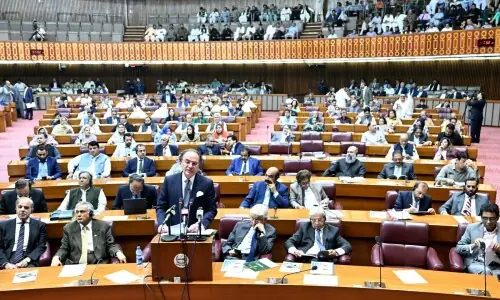
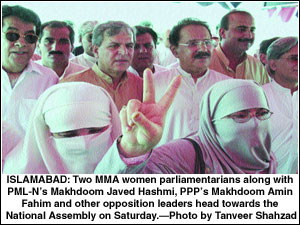 ISLAMABAD, June 28: National Assembly Speaker Chaudhry Amir Hussain on Saturday survived the opposition’s no-trust move as no vote was cast in a stormy lower house session that provoked a similar move against deputy speaker Sardar Yaqub Khan for his alleged partiality in conducting the proceedings.
Later, the opposition leaders told journalists that they would also repeat the failed move against the speaker. But they gave no date in this regard.
They said 110 opposition members had signed the notice for the no-confidence resolution against the deputy speaker that they had delivered to the assembly’s secretary.
Under the rules, an assembly session must be called seven days after the receipt of such a notice.
The no-trust move against the speaker was officially rejected after no votes were cast either in its favour or opposition after the deputy speaker made short work of what would have been a prolonged tirade against his senior.
The opposition’s resolution had called for the removal of the speaker for having transgressed “his authority by a ruling on the Constitution ... Undermining the sovereignty of the House, which was beyond his purview regarding the LFO’s status vis-a-vis the Constitution”.
While the coalition had decided beforehand to abstain from the voting on the issue, the opposition also decided at the last-minute to “boycott” the vote to protest against the deputy speaker’s decision to disallow members other than the 12 sponsors of the resolution and the speaker to deliver speeches.
The opposition accused Yaqub Khan, who chaired the session while the speaker stood in the dock, of flouting the rules by not allowing them to express their views on the resolution.
The deputy speaker’s insistence that he was following the rules in using his discretion plunged the all-graduate house into an uproar.
The National Assembly initially seemed to be proceeding smoothly after 143 opposition members — more than the required one-fourth of the 243-seat house — stood in their seats to allow the resolution to be moved and one of its 12 sponsors — Syed Naveed Qamar of the People’s Party Parliamentarians was allowed to deliver the first speech before the prayer-cum-lunch break.
Members of the ruling coalition — who were not officially counted at the time — also stood up to demonstrate their support for the speaker with minister of state for parliamentary affairs Mohammad Raza Hayat Harraj saying: “We oppose it.”
Several members from both sides were absent from the Saturday’s session for various reasons.
The trouble started when the house resumed after the break and the deputy speaker asked the next mover, Liaqat Baloch of the Muttahida Majlis-i-Amal to speak with the condition that no more than the 12 movers and the speaker would be allowed to speak before the secret balloting.
Protests by opposition members became nosier when, at one point, Yaqub Khan reminded them that he could order the sergeant- at-arms to remove any one obstructing the proceedings.
In what the opposition called another change of mind by him at the instance of the treasury benches, Mr Khan later said he would allow the remaining 11 opposition sponsors only 15 minutes each to speak, instead of 30 minutes each they said were allowed under the rules of procedure.
Baloch and other opposition members listed as resolution movers and called by the chair to make their speeches declined to do so unless their party leaders and other members were also allowed time to speak on the matter.
But the deputy speaker said he would not change his “firm decision,” rejecting charges that he was taking orders from the treasury benches.
The noisiest moments of the house came as the deputy speaker asked the speaker to defend himself.
Though hardly heard inside the hall because of the opposition desk-thumping and “No, No” chant, Mr Hussain defended his ruling as justified and said he would stay in office because he enjoyed the support of the majority of the house.
Later, the chair ordered for voting on the resolution after Mr Hussain’s speech.
Nobody either from the opposition or the treasury benches came forward to cast their vote as the assembly secretary, Salim Mahmood, called the names of all 342 members of the house in the order of the number of the constituencies.
At the end, a green, empty ballot box was unlocked and shown to the house.
“Since no one has voted...consequently the resolution stand rejected,” ruling coalition member Riaz Pirzada, who was chairing the session at the time, said before reading out a prorogation order for the assembly issued by acting president Mianmohammed Soomro.