0
0

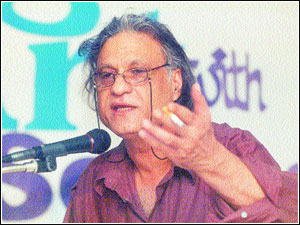 ISLAMABAD, June 27: Poet, screen writer and film director, Sarmad Sehbai, wants the artist to subvert the “mainstream” to produce the real art.
At a dialogue with him on Art at the Pakistan National Council of the Arts on Wednesday evening, he thrilled the audience with a style all his own, as he unfolded his rather abstruse ideas on art (focusing understandably on drama which is his main forte) in a mixture of ‘teth’ Punjabi, Urdu and English.
Sehbai thinks that the process of control started with the Industrial Revolution, and the consumer society continues to keep it intact. In Pakistan, the culture of the elite has constructed shibboleths from which the mainstream art cannot extricate itself.
He thinks that the artist dances around the four yard rope in the hand of the conjurer who directs him with the fear of stick; an endless circle of similes, metaphors, narrations, eulogies and superficial themes follow. The “monkey” knows meanings of all the signals of the conjurer and alternates the acts accordingly.
What can be done in this century of “consciousness”? Sehbai asked. Information technology is all around us. Take the media. First, there were two channels. Now there are 50. Media explosion is taking place. Satellite stares at us round the clock. And we stare at it. One cannot imagine anything that is not just one click away from us. Now everything is dot.com. Love.com, poetry.com, God.com. Now every one is dotcom.
So Sehbai would turn to the unconscious. In Madonna’s dance Sufis from Konia are shown taking part. Knowledge, according to the Sufis, that does not depend on “Wijdan” (intuition) and “Irfan” (understanding) is dead knowledge. It is worst kind of fascism.
He remembered Maulana Rum. He is sitting with his five hundred pupils, and is surrounded by books. Shams Tabrez, the majzoob (one lost in divine meditation) appears, and looking towards the pile of books, asks: “Een cheest?” (What is this?) Maulana Rum, proud of his knowledge says: This is something that you do not know. Shams Tabrez glances towards the books with piercing eyes. They catch fire. Now, the Maulana, feeling nervous, asks what this is. Shams Tabrez replies, this is something that you do not know. And, then in what he described as an Epilogue, Sehbai said that he first read the kalima of la (negating all) so that he could rise in khawab-e-adam (the dream of the Hereafter) and purge himself of the ego, fame and the worldly filth. The lust for fame and eternal life changes the love of poesy into intoxication. One cannot hear the heavenly voice in this din and clatter. One does not get the time to speak to oneself. Freedom from this buzzing sound is, perhaps, the only way to come back to oneself.
Sehbai, who has been the pioneer of the avant garde in the field of theatre and video film with his very first play the Dark Room, also showed clips from his well-known Naya Qanoon and Fankar Gali. He told how he manoeuvred the TV authorities into showing this on the Golden Jubilee celebrations when he was asked to base it on Manto’s short story. He also said that some of the scenes of Fankar Gali which could have been censored were left out. Others were heavily censored, because those doing it could not understand the psychological settings of the characters.
The usual questions like ‘should we see things from the perspective of Dajla (Tigris) and Furat (Euphrates) or Ravi and Indus were also put to him and his reply was that the Pakistani artists should be familiar with his surroundings before jumping to other perspectives. He was critical of state institutions like Lok Virsa which rather than propagating Pakistani culture restricted them to museums. He felt that Pakistani culture was reflected in things like urs where people from far off corners gathered without invitations. He called folk music the music of the mother, of the motherland. Talking of the power game at all levels, especially in the world of art he said that even the dates for art events at the art councils were controlled by the mafia.
Taking part in the discussion, eminent educationist, Prof Khwaja Masud argued that the world was becoming one because of the media. But Sehbai explained that there was always the struggle between the Apollnarian and the Dionysian. And the divisions were becoming more obvious.
His view of the genuine art he, perhaps, summed up in this pithy sentence: “There are thousands of ghee tins which carry sunflowers around them but can anyone of them be a match to the one painted by Van Gough”.— Mufti Jamiluddin Ahmad