0
0

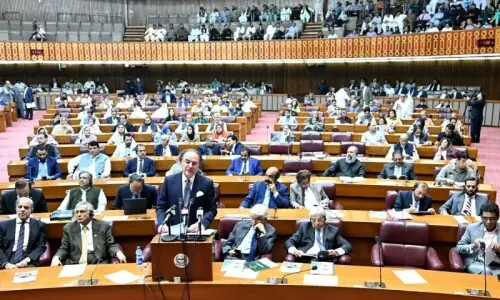
ISLAMABAD, June 13: The National Assembly on Friday approved all government demands for grants in the federal budget for fiscal 2003-4, which was set for passage on Saturday after what would be Pakistan’s shortest budget debate because of an opposition boycott.
The rapid approval of a total of 158 demands for government ministries, divisions and departments amounting to more than Rs663 billion without any opposition followed the conclusion of a four-day general debate on the budget with Finance Minister Shaukat Aziz announcing five tax reliefs, including withdrawal of some proposed increases.
Speaker Chaudhry Amir Hussain said the Finance Bill to give effect to the first budget of Prime Minister Zafarullah Jamali’s government, which aims at increasing the tax base without imposing any new taxes, would be put to vote on Saturday.
The bill was earlier expected to have been passed by the end of lower house’s second sitting of the day in the evening, but the meeting was cut short after it was informed of the death of Mr Mairaj Khalid, a former National Assembly speaker and a former caretaker prime minister.
Winding up the general debate in the morning sitting, the finance minister said the finance bill would be amended to give effect to the five tax reliefs he announced for the benefit of the construction industry, agriculturalists, saving scheme investors, babies and heart patients.
The approval of the demands for grants in the evening sitting was done in a rapid-fire manner as no cut motion was moved to raise a discussion in the absence of opposition parties.
The speaker cited about 115 cut motions sent by various opposition members but dropped them as none was moved because of the absence of their authors, leaving the finance minister with a laborious exercise of rising on his seat in quick succession to move each of the 158 motions for demands for grants.
The only relief for him came when the house briefly recessed for Asar prayers.
The opposition parties had planned to move about 1,000 cut motions to prolong the debate, but changed their plans after they decided to boycott the debate as part of their protest against the LFO, an opposition source said.
There was also no debate on the charged expenditure included in the demands for grants and appropriations of more than Rs1.388 trillion — including repayment of domestic debt of more than Rs1.076 trillion — listed for discussion.
Under the Constitution, the charged expenditure can be discussed but cannot be put to vote.
The finance minister also laid before the house supplementary demands for grants and appropriations for fiscal 2002-3 ending on June 30.
In his speech to wind up the general debate, Mr Aziz regretted the opposition boycott for the fourth day running but praised ruling coalition members for endorsing the government’s economic policies that he said was aimed to rid Pakistan of what he called the “begging bowl culture” of dependence on foreign donors.
The tax reliefs, he said had been made on the demand of house members or to benefit hard-pressed groups, are:
• Proposal to increase import duty on dumper trucks to 100 percent from 40 percent withdrawn to help construction activity.
• Duty on bulldozers and angledozers reduced to five percent from 10 percent to benefit the agriculture and construction sectors.
• Proposal to impose withholding tax on investments of Rs150,000 or less in the National Savings Scheme withdrawn to give relief to low-income investors.
• Exemption of milk preparations such as baby food from sales tax, which was proposed to be withdrawn, to be retained to avoid any increase in the prices of such preparations.
• Medicines used by heart patients for angioplasty such as balloon catheters and stents, exempted from customs duty and sales tax to reduce the cost of the treatment of heart ailments.
At the start of the morning sitting, the opposition members — as they did on the previous three days of the boycott — walked out of the assembly hall chanting slogans against President Musharraf and the LFO.
Leaders of the combined opposition, which includes the People’s Party Parliamentarians, Muttahida Majlis-i-Amal, the Pakistan Muslim League-N and their smaller regional allies, later told a news conference that their parties would continue the boycott and protest against the LFO.
Mr Aziz said the government had tried hard to persuade the opposition members to take part in the budget debate “because we believe in democratic principles and mutual understanding”, particularly on an issue like the national budget that concerned every citizen of Pakistan.
“In our view, every member of the opposition could play a constructive role in budget-making, but they have not fulfilled this duty of people’s representation,” he said.
The speaker asked the finance minister to wind up the general debate after speeches by seven more members of the ruling coalition, all of whom praised the budget, as has been the case during the previous three days of the debate.
“The opinion of the assembly members has made it clear that they endorse the economic policies of Prime Minister Zafarullah Jamali and his government as well as the continuation of the economic policies implemented by President Musharraf in the previous three years,” the minister said about the debate.
He said the budget had planned many steps to realise its philosophy that mainly aimed at increasing the gross domestic product growth, expediting investment, creating employment opportunities, improving infrastructure, investment in social sector and human development, and improving governance.
These steps, he said, would include an expenditure of Rs160 billion on development programmes that would be equal to the defence budget, development of the agricultural sector and water supplies, allocation increase of 15 percent for social sector and poverty reduction to Rs185 billion from Rs161 billion and 80 percent for education.
The seven members who took part in the general debate on Friday included Millat Party chief and former president Farooq Ahmad Khan Leghari, who demanded an early constitution of the new National Finance Commission and announcement of its award for provinces.
He described growing unemployment a “time bomb” and called for the creation of the necessary enabling environment for local and foreign investment that would create more employment opportunities.
Other speakers included M.P. Bhandara PML-Q, Wasi Zafar PPP-Patriots and Dev Das-MQM.