0
0

KARACHI, June 3: Well-known scientists, technologists and academicians of the country who assembled in the Aga Khan University’s auditorium on Tuesday, while describing the water as a scarce commodity in Karachi, urged the policy-makers to immediately draft plans to treat and reuse urban waste water, besides creating awareness about water conservation.
They advocated the application of various options to resolve the problem, such as desalination of sea water and use of nuclear technology, biotechnology, laser technology and construction of coal-based power-cum-water plants for sustainable use of water.
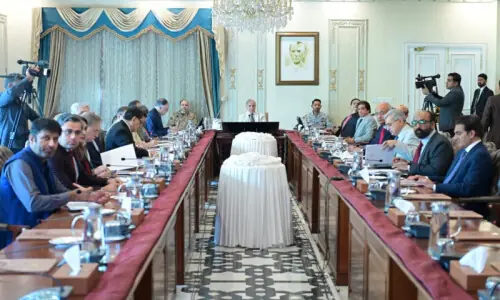
The occasion was a workshop on “Management of Water Resources and Technology Options” held at the AKU auditorium under the aegis of the Global Change Impact Studies Centre.
The prime minister’s special adviser Dr Ishfaq Ahmed presided over the seminar. Those who read their papers included the chief of the city’s water and sanitation department, Brig (Retd) Sardar Javed Ashraf, the dean of Karachi University’s science faculty, Dr M. Altaf Khan, PCSIR’s former director-general, Dr Arshad Ali Baig, SUPARCO’s former member, Dr Ishaq Mirza, an expert on arid irrigation, Dr M.H. Panhwar, Orangi Pilot Project’s director of research and training, Ms Perveen Rahman, chairman of the National Environmental Consultants, Dr Junaid Ahmad, Eco-coastal department’s (IUCN) director, Tahir Qureshi, Sindh Agricultural Forestry Workers Organisation’s Dr Yameen Memon, Nara Canal Area Water Board’s Ghulam Mustafa Ujjan, Karachi Agriculture Lab’s Dr Mujtaba Naqvi, and biochemist and irrigation consultant Ms Farzana Panhwar.
Terming water ‘a great Divine bounty’, Dr Ishfaq Ahmed said there was a dire need for increasing the water storage capacity, pursuing aggressively harvesting of rain water, and also treatment and use of urban waste water.
Highlighting the importance of different modern technologies, he said satellite images covered large space expanses to provide synoptic views; lasers saved time in levelling fields thereby conserving water and increasing cropping intensity; radioisotope techniques traced water reservoirs and water movements in regions which would be inaccessible or prohibitively expensive with conventional methods; biotechnology helped develop crops suited for water scarce conditions; and water informatics provided useful database for rainfall, runoff, water table depth, water quality.
He was of the view that the new technologies, supplemented by the conventional wisdom of farmers, properly managed and implemented on the fields, might herald an era of plentiful water to meet the nation’s requirements.
Emphasizing the need for augmenting the water resources, the PCSIR’s former D-G, Dr Arshad Ali Baig, said production of more water could be attained by flash evaporation or vaporization and condensation and reverse osmosis process.
He said the Chinese’ offer for setting up of power plants could be used for water if they were run on coal. A power-cum-water plant set up for producing 10 megawatt electricity and 3 million gallons of water per day by using coal would cost less than $800 million and the advantage of using sea water was that each litre would provide iodized salt as byproduct.
The water and sanitation department’s executive district officer, Brig (Retd) Javed Ashraf, said the city’s water crisis was due to a gap of 150mgd of water between supply and demand, adding the K-III project which was currently being executed would provide an additional 100mgd by year 2005, thereby raising the total supply to 680mgd.
He, however, cautioned that since the city’s population was increasing by 5.5 per cent per annum (2.5 per cent increase in local population and 3 per cent owing to urbanization), even 680 mgd would be insufficient for the megapolis.
Karachi University’s Dr M. Altaf Khan, presenting his paper on the subject of “Passions and Rationale for Recycling Water”, deplored that 10 million people died each year from water related diseases and more than a billion lacked access to safe drinking water in the world.
Emphasizing the need for adopting biological systems, he said chlorophyll molecules could be directly used in purifying contaminated water. There was also a need for increased water availability for human use and food production but all this required political will and commitment.
Dr Mujtaba Naqvi of the Agriculture Lab was of view that saline water could be used for salt tolerant plants including cactus, pistachio, date palm and even vegetables. “In fact, we can make man-made oasis by using saline water for salt tolerant plants,” he added.
The OPP’s director of research and training, Ms Perveen Rahman, was critical of the W&S department’s performance, saying though a lot of water went to waste through leaking pipes or pilferage, the professionals hesitated in accepting the ground realities.
Dr Junaid Ahmed said both rural and urban areas of the country, including Karachi, Hyderabad, Quetta, Sukkur and other large and small cities, were facing water shortages increasingly.
Adding that overuse of pesticides and chemical fertilizers in the country raised new problems of pollution, he warned that indiscriminate use of pesticides could lead to pesticides contamination and mass killing of fishes, excessive nutrient loading of waterways and uncontrolled growth of algae.
In his welcome address, the AKU’s President Shamsh Kassim- Lakha, regretted that rate of population growth was putting pressures on the scarce water resources and as such the availability of water per capita had been reduced by five times since independence (5000 cusecs per month to 1000 cusecs per month).
He said only one per cent of the world’s water supply was available as fresh water and even that was not distributed evenly.
Samir Hoodbhoy of Data Communication and Control conducted the proceedings of the workshop, besides chairing the workshop’s second session held on the subject of “Applications of Modern Technology”.
Earlier, a book entitled “Water and New Technologies”, edited by Dr Ishfaq Ahmad, was launched.