0
0

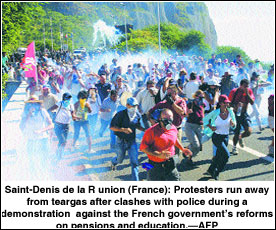 PARIS, June 3: Public sector strikes paralysed parts of Europe on Tuesday, causing mayhem in France and Austria and lesser disruption in Germany and Italy.
The French strikes, the second nationwide stoppages in three weeks over pension reforms, hobbled train services, grounded most international flights and closed schools in a new blow to Prime Minister Jean-Pierre Raffarin’s centre-right government.
In Austria, transport and postal workers staged the biggest walkout since World War Two, also over pensions, while eastern German steel plants and engineering firms were hit for a second day by stoppages over working hours.
Italian airline Alitalia had to cancel 200 flights because of a strike by cabin staff over job cuts.
The French stoppages recall 1995 strikes which brought down the last right-wing government for trying to touch pensions.
“Anger,” read one banner at a French demonstration. “Make the jet set pay” and “Retirement for everyone at 60” read others, as marchers beat drums. Unions said 1.6 million joined the demos across France, while police put the figure at 510,000.
But Raffarin showed no sign of backing down.
“This is about the survival of the republic,” he said at parliamentary question time.
French unions are up in arms over plans to make workers pay into the state pension system for 40 years, while Austrian workers are fighting plans to cut pensions by around 11 per cent.
The authorities in both countries are fighting to stave off a financial crunch in the pensions systems as populations age.
“You can’t strike against demographic developments like that,” Austrian Education and Science Minister Elisabeth Gehrer told Austrian radio.
Thirteen years after reunification, striking workers in Germany’s former communist east are fighting for the same working hours as their western colleagues, but there again, the authorities say the economy cannot support such a change.
TRAVELLERS STRANDED:A 24-hour walkout by air traffic controllers cut 80 per cent of flights to and from France, although skeleton train and bus services were running. Electricity output fell by five percent and few national newspapers were printed.
French teachers, furious at plans to decentralize education funding as well as at the prospect of working past 65, staged their 10th walkout in as many months. Unions called for more action on June 10, two days before “Baccalaureate” secondary school exams start.
But half the trains were expected to run on Wednesday — a vast improvement from May 13’s “Black Tuesday” walkout, when transport paralysis gripped France for two days after the original strike.
German workers wearing red strike vests rallied at the factory gates of a Volkswagen plant in Mosel and at other engineering firms in the region. They want a reduction in workers’ weekly working hours to 35 from 38 currently to bring them into line with western Germany.
In Austria, buses, trains, the underground rail network and trams stopped operating shortly after midnight for about 24 hours.
Groups of striking airport workers blocked the entrance road to Vienna International Airport, making it difficult for travellers to reach their terminals, but airport officials said air traffic in and out of Vienna was unhindered.—Reuters