0
0

 KARACHI, May 27: Pakistan’s nuclear capability has proved a deterrent force to maintain peace in the Subcontinent and has made the country invincible.
Nawaz Sharif and all other authors of the nuclear programme, including Zulfikar Ali Bhutto and scientists Dr Abdul Qadeer Khan, deserved gratitude for their wisdom, courage and taking daring decisions to raise the stature of the country and turned it into a invincible nation to the enemy.
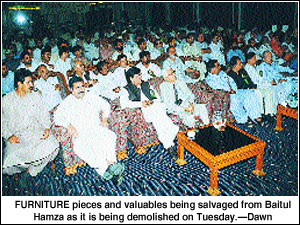
This was the gist of speeches delivered at a seminar organized by Pakistan Muslim League (Nawaz), Sindh, at a local hotel on Tuesday in connection with “Yaum-i-Takbeer” to commemorate 5th anniversary of Pakistan’s nuclear tests of May 28, 1998.
Speakers at the seminar were PML-N leader Raja Zafarul Haq, journalist Sarwat Jamal Asmai and Sajjad Mir, Prof Shamim Akhtar, PML-N Sindh chief Imdad Hussain Chandio, and JI deputy chief Senator Ghafoor Ahmed.
PML-N central leader Sardar Rahim introduced the subject, “Yaum-i-Takbeer: Milestone for peace”, while Mamnoon Hussain presented vote of thanks.
Recalling reaction of Muslim countries after the tests Mr Haq, in his presidential remarks, said that not only Saudi Arabia and Iran had offered to meet Pakistan’s requirement in face of sanctions but Egypt’s Hosni Mubarak had said: “Now we consider ourselves secure.”
He said not only US president Bill Clinton had advised Pakistan not to go for the tests in response to Indian challenge, but our “powerful quarters” were of the same views and had to be convinced about the importance of the tests.
Pointing out that future of Pakistan depended on its nuclear programme, Mr Haq said that soon after Nawaz Sharif was removed from power, a propaganda was unleashed by the US that there was no system of nuclear command and control in the country which came to halt only after Dr Abdul Qadeer Khan and his associates were removed from Kahuta.
The PML leader said that at such a juncture the nation needed unity, cohesion and consensus of all political forces in the country.
“Had Pakistan not adopted a weak foreign policy on the eve of the US assault on Afghanistan, Washington would not have dared to target Iraq,” he added and said: “Now Joseph Lieberman — a would be runner for the future Democratic Presidential election — was talking of a change in Iran, and pressure was mounting on Saudi Arabia, Syria, and Lebanon.
“Even they have set an eye on Pakistan and Malaysian Prime Minister Mahatir Mohammad for his courageous statements.”
Referring to speculations about flexible attitude of some opposition parties regarding the LFO, the PML-N leader hoped that political leadership would fulfil its responsibilities.
However, he warned that any deviation from the principled stand would prove fatal and the nation would never forgive such leaders.
Prof Ghafoor Ahmed of the Jamaat-i-Islami said that May 28, 1998, tests were the outcome of political leadership in the country. “If the army is in power it can not defend itself what to talk to defend the country and 1970 events were its proof when the army not only failed to defend the solidarity of the country but surrender in large numbers before the enemy,” he added.
He said that in 1973 Zulfikar Ali Bhutto despite majority in the Parliament gave proof of wisdom by accepting 29 amendments in the Constitution which had changed the entire structure of the government.
Pointing out that many problems had engulfed Pakistan, he said that the army was not coming up to the expectations.
Mr Ahmed said that Gen Yahya Khan had given the nation an LFO and the country suffered a split, and at present again the army wanted to have a sole right to rule the nation.
Sajjad Mir said it was Pakistan’s nuclear capability which had forced the Indian premier to travel to Lahore, invited Pakistani leadership to Agra and had again offered talks to settle all issues.
Prof Shamim Akhtar lamented that Pakistan had handed over five Pakistani nuclear scientist to the FBI and was given a free hand regarding the nuclear weapons.
He said that if the Lahore Declaration was implement, not only ties between India and Pakistan could have improved but also the Kashmir problem would have been solved. “But, today we have come to a blind alley with unforeseen future,” he added.
Sarwat Jamal Asmai said that had there been no Kargil adventure, Pakistan and India would have gone far in their relationship.
Terming the nuclear programme a milestone in the history, he said that credit for it goes not only to Nawaz Sharif but also Zulfikar Ali Bhutto, Ziaul Haq and Ghulam Ishaq Khan for its continuation.
He lamented that it seemed that instead of expressing gratitude to all those who made contribution in the successful culmination of the programme the present government was ashamed of the programme.