0
0

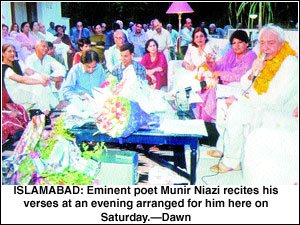 The charm of Munir Niazi’s poetry completely overwhelmed writers, poets and other admirers who had assembled to hear him at a pleasant Saturday evening of Islamabad dedicated in his honour by the Shah Husain Academy.
Even the ambience provided a perfect poetic setting for a highly significant poet of our times, (metaphysical in content, simple in narration, remarked someone at the evening). Munir Niazi received “dad” (applause) on almost every line that he read from his poems, both in Urdu and Punjabi. At times even the “koyal”, (cuckoo), singing from the thick foliage formed by the lush-green branches of trees all around, at the venue of the function, seemed to join in applause.
The poet of Kisee ko apnay amal ka jawab kiya daytay, Swal saray ghalat thay jawab kiya daytay, in Urdu and kuch sher day log we zalim san, kuch sanoo maran da shauq we see in Punjabi, briefly spoke about himself also.
He was born in Hoshiyarpur, in one of the Pathan settlements there known as Khanpur. He received his early education at Montgomery (now Sahiwal). Without telling anybody at home, he went and got himself recruited in the navy and left it because the work was not to his taste.
How he became a poet, he did not know yet. In his well-known manner (typical poetic couldn’t care less style) he also answered a number of questions from his admirers about poetry, declines in values and the poetic sensibility.
Introducing the poet, “whom she knew for more than 47 years”, poetess Kishwar Naheed said that Munir Niazi gave an environment of modernity to Punjabi literature, setting for it a new tone. She mentioned the journal Saat Rang started by him, a journal watched with keen interest about its literary content; and the publication house started by him that brought out the remarkable edition of La Musawi Insan of Noon Meem Rashid.
Sarwat Mohiuddin spoke on Munir Niazi’s diction of Punjabi shaairi and the sincerity of his sentiments reflected the social injustices of our times.
Hashim Baber, who writes poetry in Pushto and who had arranged the function at his place, spoke of the unique place the poet occupies as a narrator of a distinct Sufi thought which had perhaps taken him from Urdu to Punjabi. He thought this kind of poetic diction the poet could not find in Urdu or Persian (and even in Pushto, he thought it didn’t exists).
Ishaq Chaudhry speaking on the occasion humorously remarked that some one told him that Munir Niazi was given to Punjabi poetry on lease and should be returned back. He said it could not be done because lease usually is for 99 years.
One could see former secretaries, including Majeed Mufti, and Masuma Hasan; Muqtadara Chairman Prof Fateh Mohammad Malik, Academy of Letters Chairman Iftikhar Arif, poets Aftab Iqbal Shamim, Eshan Akber and Shabnam Shakeel besides a number of writers and poets, and his other admirers, including a number of journalists — most of whom had come to listen to him only. Most of them said it with flowers; which fitted so well with the surroundings.
This Punjabi shair of his, which would reverberate in many a mind for a long time, shows the kind of subjects that his poetry grapples with: Kitab noon pataa honda hai/kis ankh day saamnay zahir hona aea. —Mufti Jamiluddin Ahmad