0
0

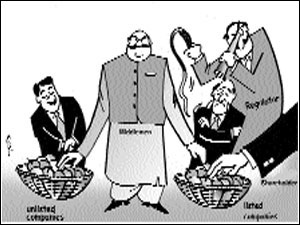 The audience burst out laughing, when in response to the proposals for the forthcoming budget presented by chairman Karachi Stock Exchange, the Finance Minister Shaukat Aziz who rose to speak latter, said almost jovially: “As we say in Islamabad, we shall ‘examine’ each demand”.
The occasion was the distribution of Top 25 companies awards at the KSE last Tuesday. Bankers, brokers, high networth individuals and captains of the country’s biggest industries were all gathered. Seldom may have such rich and powerful people gathered in one crowded hall as were that evening—people who could safely be assumed to control more than half of country’s wealth. And as their fortunes must have multiplied since January last year due to skyrocketing stock prices, the mood naturally was jubilant. Rising by a spectacular 112 per cent in 2002 and 64 per cent year-on-year, the KSE is proudly proclaiming itself as the “best performing market in the world”.
It was the perfect setting for the stock exchange to present its demands for forthcoming budget. Prime Minister Mir Zafarullah Khan Jamali, who was present with almost all his ministers in tow, listened to the budget proposals as they were reiterated by chairman KSE, Firozuddin Cassim. On his turn, reading from a prepared speech, the Prime Minister announced that he was granting immediately one of the key demands—exemption of capital gains tax. KSE had asked that capital gains tax—available for another year— upto assessment year 2004-05— be “perpetually” exempted. Capital gains tax was first imposed as far back as in 1973, but on the demands of the stock exchange, Government has been extending exemption for a couple of years at a time. There was slight ambiguity on whether Mr.Jamali had announced exemption for a year or accepted the bourse’s demand of making it a “perpetual” exemption (the agriculturist/politician PM who conceded that he was treading an unfamiliar territory, would have hardly known the difference). But that would be clearer when the budget is announced in June. The chairman KSE Firozuddin Cassim, meanwhile is sanguine that it is the latter. “Since we had requested that the exemption be perpetuated and the PM announced that the demand has been granted, it naturally follows that it is perpetual”, Cassim told this scribe. He explains that without this tax incentive it would not be possible to attract investors towards equity market for broad basing investments and industrialisation in the country. “Besides, he says, the exemption is tax neutral”, explaining that just as capital gains are exempted from tax, capital losses are also not allowed to be set off against other income.
Some other budget proposals made by the KSE, also seem to make sense. Exchange has called for removal of tax on dividend income which currently is taxable at flat rate of 10 per cent of gross dividend income. The KSE’s stand is that dividend income in the hands of recipient shareholders should be fully exempt from tax, for it constitutes double taxation since dividend is distributed from taxed earnings of companies. Chairman KSE says that 10 per cent presumptive tax is not really very high, but he argues that “It’s a question of principle”. He points out that even in the US, it has been accepted this year that taxing dividend income is double taxation and the US President, has therefore, proposed to withdraw this tax.
Another demand of the KSE that Prime Minister Jamali acceded to on Tuesday, was to step in to resolve the bourse’s long standing dispute with Pakistan Railways over a piece of land, which looks more to be an administrative issue than economics. Other budget proposals forwarded by the Exchanges include: exemption of capital gains for insurance sector; investment allowance; revision of investment guidelines and tax exemption on capital gains on corporatization of stock market membership.
Yet one significant demand that is likely to catch the government’s eye is in respect of tax rebate for listed companies. The stock exchanges say that through the finance Ordinance, 2002, government had decided to progressively reduce tax rates of private companies by 2 per cent per year beginning 2003. The idea is to remove the existing tax difference of 10 per cent between a private and public company. “This will place private companies at par in tax treatment with listed companies from 2007 onwards”, the KSE says. The decision would go to discourage listing by new companies on the stock exchanges since there would be no incentive for listing in the context of tax benefits. Tax difference partly compensated for greater amount of responsibilities, costs and accountability process that managements of listed companies have to undergo vis-a-vis the unlisted companies. Such argument seems to hold water for listed companies share the benefits and fortunes with public shareholders and they need encouragement and less tax as compared to non-listed companies. In this respect the bourse has asked that annual cut in tax rate by 2 per cent allowed to private companies may also be made applicable to listed companies, so as to maintain the present difference of 10 per cent between listed and unlisted companies.
Just as the Prime Minister suggested, stock exchanges must make greater efforts to mobilise capital through new listing of equities. But the Government must realise that unless the benefits of listing outweigh the risks and responsibilities, it would be imprudent for corporates, particularly the smaller ones to enter the capital market. In spite of the fact that the stock market is in the grip of an unprecedented bull run and wallowing in liquidity, companies are not lining up to enter the capital market. Only five new companies have been listed at the KSE since September 2001: Fayzan Modaraba, WorldCall Multimedia, NBP, Bosicor Refinery and Attock Cement. A reason of course is that cost of raising funds from banking system is at its lowest ever and companies find it convenient to seek money from banks rather than go through time-consuming equity financing.
Smaller companies also have to run faster to keep up with the costs and inconvenience involved in complying with the recently introduced code of corporate governance including the quarterly results announcements within limited time frame. It is difficult to argue with the truth that listed companies should be properly monitored and kept under a perpetual process of accountability, for they are the trustees “ameen” of public money. But concurrently, they should also be given proper incentives to encourage them to enter and not leave the capital market. As it happens, five new companies sought listing at the market in about the last year and a half, while six companies asked for voluntary delisting in 2002 alone.