0
0

UNITED NATIONS, May 21: The Security Council is expected to approve on Thursday a US bid to lift UN sanctions on Iraq after Washington offered fresh concessions to reassure countries seeking a greater UN voice in Iraqi reconstruction, diplomats said on Wednesday.
The council scheduled a vote on the draft resolution at 9.30am (0630 PST) on Thursday and diplomats said Washington and co-sponsors Britain and Spain hoped for the support of as many as 14 and perhaps all 15 council members.
The latest draft marked the third set of revisions since the initial version of a text was released last week.
Among earlier doubters France, Germany, Russia, China and Syria, Germany was “definitely on board”, with the rest still undecided, the diplomats said.
“Our impression is that the council members have welcomed this resolution and that it enjoys strong support,” US Ambassador John Negroponte said. “If a consensus were possible, that would be very desirable.”
“We now hope that there will be a maximum number of positive votes for this highly improved text, which we have worked on over the last few days. So — a vote tomorrow morning,” British Ambassador Jeremy Greenstock said.
Washington had initially hoped for a vote on Wednesday, but delayed after council members suggested dozens of changes in the 12-page draft during a four-hour closed-door debate on Tuesday.
The resolution would end nearly 13 years of UN sanctions, imposed on Iraq after its 1990 invasion of Kuwait, and also phase out strict UN controls on the Iraqi economy.
FRENCH STANCE: One question was whether France, which infuriated Washington by leading the charge against UN authorization for the invasion, would vote “yes” or abstain.
Concerned at the lack of a deadline for installing a new Iraqi government, Paris wanted the resolution to lapse after a year, at which time the council could review its implementation and decide whether or not to renew it.
Washington opposed this but agreed instead to provide for a council review within 12 months, at which time it could take any further steps it deemed necessary.
But the new draft failed to meet a Russian demand that UN inspectors be allowed to return to Iraq to certify that its chemical, biological and nuclear weapons had been eliminated.
While Washington has left the door open to a possible future change of heart, it has so far flatly refused to bow to previous United Nations resolutions requiring that, before the sanctions can be lifted, the inspectors must certify that all Iraq’s mass destruction weapons have been destroyed.
The point is a particularly sore one because the United States said it was invading Iraq to disarm it, but so far no chemical, biological or nuclear weapons have been found.—Reuters
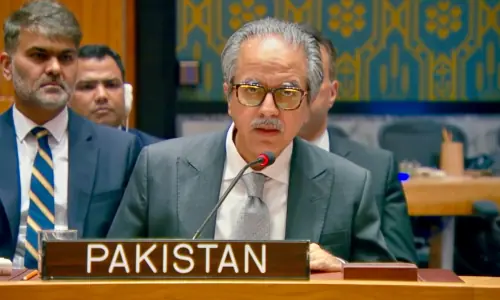
MUNIR AKRAM: Pakistan’s UN Ambassador Munir Akram, the council president, expressed the hope that the resolution “could be supported by all members,” Masood Haider adds from New York.
Diplomats said the resolution was certain to get 12 “yes” votes in the 15-member council, with only France, Russia and China’s votes in question. The three, who are permanent members that opposed the war against Iraq, have made it clear that they would abstain — and not use their vetoes — if they couldn’t support the final draft.
The US wants an unanimous vote on the resolution.Many council members had complained there was no end to the US and British occupation in the resolution. Many also pressed for a bigger role for the UN in postwar Iraq — especially in building a new government — and for the council to have a significant role in monitoring the country’s reconstruction.
However, US Ambassador John Negroponte insisted the US would not stand for any time limits on how long it could administer Iraq — a reference to a French suggestion that it be for one year and not open-ended.
In a concession, however, the US agreed to allow the Security Council to review how the resolution was being implemented after one year, diplomats here said.
The latest draft gives the UN a stronger role in establishing a democratic government than initially envisioned and increases the stature of a United Nations envoy in Iraq.
But it also leaves the United States and Britain, as occupying powers, firmly in control of Iraq and its oil wealth.