



 0
0

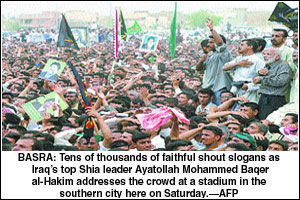 BASRA, May 10: Iraq’s top Shia leader, Ayatollah Mohammed Baqer al-Hakim, returned home in triumph on Saturday, greeted by tens of thousands of supporters after 23 years of exile in Iran.
People carrying the ayatollah’s portrait lined the 10-kilometres route from the desert border post at Shamsaleh to Basra.
As his motorcade rolled into the city, tens of thousands of curious onlookers turned out to catch a glimpse of the man who is a future political leader for some and a religious figurehead for others.
British troops kept a close but very discreet eye as tens of thousands more gathered at the city’s main stadium for a rally addressed by the ayatollah.
The 64-year-old head of the Supreme Assembly of the Islamic Revolution in Iraq (SAIRI), crossed into Iraq early in the morning.
“Yes, Yes, Islam ... Yes, Yes, Hakim,” the crowd chanted at the border. “Sunnis, Shias, no difference ... all united behind Islam. He will not agree to join an interim government,” said a SAIRI official, referring to US plans. “He’s above all that. He is a spiritual leader and a spiritual leader is more powerful than a president.”
After bringing the city to a standstill for several hours, the ayatollah issued an impassioned call for national unity and a stern no to “imperialism” as he addressed tens of thousands of men at a downtown stadium.
“We now have to know our own way to rebuild Iraq, and forget the past. We Muslims have to live together. We have built security for our new society. We have to help each other stand together against imperialism,” he said to chants of “Allahu Akbar”.
But Ayatollah Hakim was also at pains to present himself as a spiritual leader — rather than a man to be compared with Iran’s hardline revolutionary leader Ayatollah Ruhollah Khomeini.
“We are Muslims. We want the Iraqi people to govern themselves. We want a democratic government, representing the Iraqi nation, the Iraqi people, the Muslims, Christians and all the minorities,” he said in a 45-minute speech. “We want an independent government. We refuse imposed government.”
An aide to Ayatollah Hakim said a SAIRI convoy of four-wheel drive vehicles would over the coming days tour southern Iraq before he returns to his birthplace in Najaf.
The Shia leader, who had been greeted in the no man’s land between the two border posts by senior SAIRI figures, was not immediately scheduled to travel to Baghdad, the aide said.
The ayatollah was protected by bodyguards in civilian clothes from the group’s armed wing, the Badr Brigade, which has been accused of trying to infiltrate from Iran to spread Iranian influence across Iraq, something Tehran denies.
In Tehran, as Ayatollah Hakim prepared his return, he made a final speech in exile during Friday prayers, telling the faithful that Iraq’s future belongs to Islam. “There is no time now for me to talk to you in detail about the future of Iraq, but I tell you the future of Iraq belongs to Islam,” he said, committing himself to that struggle.
“Independence is our greatest priority ... Iraqis must be able to decide on their future, something they have not been able to do up to now.”
The opposition chief had originally been set to return to Iraq on April 28, but his trip was cancelled without explanation.
Ayatollah Hakim’s brother and deputy, Abdul Aziz, has been in the country since April 16 and has represented the movement at meetings of the former Iraqi opposition working toward setting up an interim government in Iraq.
While SAIRI objects to the presence of US and British forces in Iraq, it has taken the pragmatic decision to participate in the process, which is being steered by Washington.
The group is a member of a council of former opposition groups that are spearheading the process. The council also includes the Kurdistan Democratic Party, Patriotic Union of Kurdistan, Iraqi National Congress and Iraqi National Accord.
But SAIRI’s involvement in the process has not been unconditional, and its participation was not always certain.
The group attended the April 29 meeting under the chairmanship of US civil administrator Jay Garner that agreed to hold a national congress within one month to start setting up an interim government.
But Mullah Abu Ahmed, SAIRI chief in Basra, said that future participation depended on Washington respecting the Iraqi people’s wishes and on an agenda that was not contrary to their interests. —AFP\Reuters





























