0
0

ISLAMABAD, May 4: Rival negotiators will meet on Monday to begin probing what critics see as a constitutional minefield laid by President Pervez Musharraf’s Legal Framework Order but regarded by his loyalists as a cure for misrule.
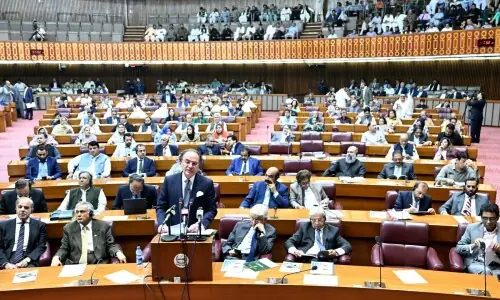
A joint constitutional committee of the ruling coalition and the opposition parties is due to meet at the parliament house at 10.30am for detailed discussions mainly on the LFO’s most contentious seven points it identified in its inaugural meeting on Friday.
But despite initial optimism voiced from both the ruling coalition led by Pakistan Muslim League-Q and the combined opposition, political sources keep their fingers crossed about the possibility of a success of the talks within the present deadline set for May 15.
By then the committee, chaired by National Assembly Speaker Chaudhry Amir Hussain, is required to thrash out agreed points of the controversial LFO and draft a constitutional package for approval of the political parties and later by parliament.
But a confusion prevails on whether the entire LFO will be taken to parliament in an amended form or only the agreed points while the rest of this package of presidential decrees stays as part of the Constitution.
Political sources said a controversy of this issue could block the talks, which have followed the loudest protest shouting in Pakistan’s parliamentary history by opposition parties.
While MMA’s Qazi Hussain Ahmed said on Saturday the government had agreed to take the entire LFO to parliament in the form of a bill, the PPP said it had no such information.
“So far there has been no clear indication from the government on this issue,” PPP spokesman Senator Farhatullah Babar told Dawn on Sunday.
“All other matters of constitutional amendments flow from this basic and fundamental principle.”
“The basic issue is whether the constitutional amendments, if any, are to be placed before parliament for endorsement...or will be foisted on the nation through an executive order,” he said.
The political sources said the most difficult issue for the committee to resolve would be the status of the president, who says he was genuinely elected to the office for five years in the controversial April 2002 referendum and must remain army chief as well as a bridge between the military and the civilian government.
But opposition parties, which have rejected the referendum result and object to the president holding two offices at the same time, say a president can be elected only by an electoral college of both houses of parliament and the four provincial assemblies.
They are divided over accepting General Musharraf as a civilian president.
While the MMA has assured Gen Musharraf to help elect him as a civilian president if he agrees to give up his position as army chief of staff, the PPP and PML-N have different plans.
“The PPP position is that when Gen Musharraf offers himself as a candidate, it will consult the ARD and other opposition parties on who to nominate as a candidate to contest against him,” Babar said.
The PML-N is not even ready to negotiate with the man who toppled its government in the October 1999 coup.
A crucial matter before the constitutional committee will also be the indemnity given by the LFO to presidential decrees such as those that prohibit provincial assemblies to amend certain laws without the president’s approval and bar former prime ministers Benazir Bhutto and Nawaz Sharif from elections and becoming prime minister ever again.
“Our position is that these ordinances and laws for which indemnity is sought must be decided on case-by-case basis by parliament,” Senator Babar said.