



 0
0

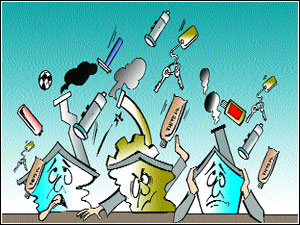 If an industrialist in Karachi’s industrial zone were to price a pack of 12 ball point pens, or a couple of battery cells, a key chain together with a small torch, for as few as Rs 5 each, he would soon have to close down the mill and would be staring up at his name among the loan defaulters.
But to compete with the flood of goods originating in the marketplace, mainly from China, local producers must sell products at a quarter of the cost of production, which of course is preposterous to expect.
But the question is: Where does the blame lie for putting local industry under such crippling pressure by opening up the flood gates for entry of foreign goods. Can countries of origin such as China be blamed for dumping cheap items of a very wide range in limited Pakistani market, driving several categories of manufacturers out of business? Is it the bureaucracy that connives with corrupt traders that are out to make a quick buck? Can manufacturing class be absolved of the responsibility for not being efficient enough to compete in a free trade environment? Is it too high cost of utilities that is rendering manufacturers uncompetitive? What about the high taxation, which the industrialists have eternally complained about? Or all in all is it the government that has failed to evolve the right mix of policies conducive to promote large scale manufacturing activity locally?
Every one is throwing the blame at the other person’s door. True to our psyche people hold everyone responsible, but themselves. Some market players even accuse consumers of non-patriotism in opting for foreign items over locally manufactured goods. What they ignore is the plight of an ordinary citizen pushed in the dark corner by the rising cost of living and diminishing purchasing power. But why, in the first place, must not the consumer strike the best bargain. What has patriotism to do with common economic sense?
It would be unfair to pin the blame on any single class of people, though: the industrialists, traders, or the consumers. In the effort to protect self interest, each stakeholder is possibly contributing his bit in pushing the situation to such a pass. Corruption and inactivity of the government, however, seems to be the main culprits. It is primarily the responsibility of government to safeguard and promote the long-term interest of the country. It has the muscle and administrative apparatus on its hand to make an impact. It is high time that the government puts its act together. The country with its problems of gigantic proportions (unemployment, poverty, dwindling social sector) stands little chance if private sector continues to perceive long-term investment in manufacturing as an unprofitable prospect.
De-industrialization cannot be condoned no matter how strong is the case for free trade. Protection to the local industry might not be the answer but level playing field will have to be ensured for the manufacturing class if the industrial activity is to be sustained and promoted. Large scale manufacturing would grow only at the desirable pace, as long as the productive activity stays viable and comparatively more profitable. Private entrepreneur, who is understandably driven primarily by the profit motive and not social considerations would invest to seek maximum gains at minimum risk.
A survey in Karachi indicates that most prospective investors are inclined not towards setting up industries, but to trade, for the latter does not lock up capital for a longer period. If undertaken with due diligence, trade ensures high returns and is comparatively hassle free. What is still more alarming are the indications that in some sectors already established entrepreneurs are weighing their options to step out of manufacturing altogether. In the words of one such industrialist, “It is no more worth the effort and hassles”. Quite many of the units in the business of producing footwear, some kinds of electrical accessories, toys and many of the fast moving consumer goods (FMCGs), have been shut down, because they lost market to imports.
There is no denying the fact that foreign items are fast replacing locally manufactured goods in Pakistani markets all over the country. Ordinary sewing needles, electronic gadgets, toys, all types of accessories, footwear, motorcycles—and the list is endless. High ranking officials in the customs department confirmed to this scribe, that eight out of every ten containers stacked at the Karachi Port, would be found to have originated either directly from China or reached Karachi through a third country. Highly porous boarders of Balochistan provide several points of entry for smugglers from the West of the country.
A glaring example of government’s apathy or perhaps its inefficiency is reflected in country’s trade figures with China. According to the official statistics, imports from China over the last five years have increased, all but, marginally. In 1996-97 net worth of import was $542.9 million. In the next five years, it rose by merely $33 million to $575.4 million by the year 2001- 02. Can anything be farther from reality. It hardly takes a little stroll to the nearby market to see for oneself how misleading the official projections are. Responsible members of marketing association in Karachi put the market share of Chinese products between 40-50 per cent. It was definitely not so five years ago One senior member of the Karachi Chamber of Commerce & Industry believes that Chinese share in our market is growing not in years or months but by every passing day. Several industrialists weary of this influx have called for stern action against the country of origin of these imported/smuggled items.
The country can no longer afford to let other nations prosper at its own cost. Half-baked, lopsided policies, however, would further complicate the situation. It is important to realise the reality of the situation. Unreliable data drawn up by arm-chair economists does nobody any good. Once the government acknowledges the seriousness of the situation, it might then involve all the stakeholders before proceeding to bring about the desired shift in its policies to create an economic environment that supports and encourages industrialisation and puts a firm ban on illegal imports and smuggled goods. But is the government likely to move quickly to redress the situation? Unfortunately, up until now, it is following in the footsteps of Mark Twain, who once remarked: “I never put off till tomorrow, what I can do the day after!”






























