0
0

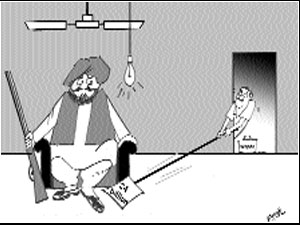 Among the many pathetic and sorry excuses Wapda puts forward for its continuing losses, the Federally Administered Tribal Areas (FATA) unpaid bills— presently amounting to an alarming Rs24 billion, now feature the most.
With the Chairman proving his management to be as innocent as the driven snow, GOP and the unpaid billions on account of the FATA attain the notoriety of the darkest of the villain. The FATA comprises of seven agencies controlled by the time-tested political agents and their levies and six frontier regions.
Here Wapda teams visit only in the company of guards provided by the PAs/ APAs and the tehsildars. And on the refusal by the tribals to clear electricity outstandings, these political agents— once the likes of Winston Churchill and Co., collect the same through levy of various cesses and duties/taxes on all goods entering FATA. Presently these very versatile officers too have stopped making payments — however the imposition of cesses and duties/taxes by them continues.
The actual position may have remained swept under the carpet had Wapda not decided to install energy meters for the as yet un-metered electricity connections in FATA during early 2002. The tribals, on the other hand trigger happy to start with, took quick exception to this scheme— which in fact was destined/ planned to cut the billing holiday they had been enjoying in collusion with PESCO—Wapda’s battered corporatized off-spring which has still to be baptized in the private sector- though EOIs (expression of interests) have been called for financial advisors who would help in (eating the pudding) the privatization process.
Experts opine that PESCO could never be privatized in the near future and the exercise of appointing financial advisors for this specific purpose would just end up in more losses and nothing else. Indeed some blue eyed ones could get satiated.
Wapda (through PESCO) needed to install the energy meters as the earlier fixed tariff had just given way to a newer version based on per unit consumed rates. And this was to be a manifold increase in the monthly bills against the appropriate method of gradual increase and concurrent provision of the imperative metering equipments. As expected, the force of tribal guns, the run-off of the famous referendum and lastly the elections led to a stalemate with the scheme of energy meters in FATA put on hold.
This was of-course a boon for the hapless Chairman Wapda struggling to shake off the Rs41 billion loss for the FY 2001-02 and the looming but similar loss for FY 2002-03. He, however, instead of admitting fault, holds FATA, its unpaid billions and the guarantor viz GOP for all his ills. Probably, every one who matters believes the truth to be so.
Moreover seeing the good tribals manning road blocks and machine guns nests in FATA is indeed sad and cause for great concern. The recent blowing up of the 66 kv Shabqader-Ghallanai transmission line tower is another off-shoot to the problem. This is not the first of such acts as chronologically Warsak Canal was breached in Khyber Agency on 16/01/2001, two 66 kv towers were damaged in Ghallanai, Mohmand Agency on 1/4/2002, the Landikotal- Jamrud Road was blocked on 6/04/2002, a mob snatched a Wapda jeep on that very day, a strike was called in North Waziristan Agency on 9/04/2002, 132 kv grid station was damaged by a mob on 12/4/2002 at Mir Ali, a tower of 132 kv line of the Bannu-Miran Shah line was blown up on 19/4/2002, a Miran Shah Jigra fixed head- money of Rs. 1 million for a Wapda XEN, Bajaur Agency Jigra passed an order to kill any Wapda men seen in the area and lastly has been the ongoing strikes in all of FATA against the meter- installation campaign.
Similarly abhorring are the many novel methods of billing the tribals by the PAs and their staff—which include a fee on the issuance of identity cards and special levy on all commodities and goods meant for this area.As a last resort comes the Wapda cut-off of supply to various areas on account of default. All this negates the oft repeated promise of successive governments to alleviate the lot of backward areas of the country.
As FATA’s unpaid bills are upwards of Rs24 billion - a colossal amount, there arises a need for an in-depth study. In order to do so we would need to understand the original subsidized tariff, Wapda’s infra-structure in FATA, the application of Wapda rules and regulations there, why energy meters were not provided/installed in the first place, monthly billing, line losses in that area and the loss/profit of electricity operations there.
As a consequence, we need to list the original subsidized tariff rates, the details of the tariff made applicable to FATA from 23/3/01 onwards and the special tariff levied on orders of the then CE and now President from 29.06.2000 onwards. Thence would come NEPRA’s dispensation of 6/11/01, which allowed Wapda to charge normal tariff as applicable to the rest of the country.
Side by side has been Wapda efforts to withdraw subsidies and introduce unit rate system in FATA actually from 1/1/99, when on the other hand it has been also charging a special tariff of Rs1.55 to Rs1.97 per unit under instructions of the then CE.
As all this was done half-heartedly, it failed to produce any worthwhile results. We would also delve into NEPRA — the regulator’s mind-set regarding cross-tariff subsidies and the IMF/WB conjured vision of different tariffs for different areas based upon the financial viability of each DISCO (Wapda’s corporatized distribution companies).
Actually it was because of this cross tariff subsidy that Pakistan could have a uniform tariff for the country and could also afford special concessions for FATA, NWFP and Baluchistan tube-wells, etc. The WB/IMF, on the other hand, as is the practice in developed states, desires the cost of service-based tariff- a prerequisite if the loosing Wapda DISCOs were to ever privatize. It is besides the point that in the near future this could only lead to a tariff of around paisa 300 per electricity unit for Lahorites, with the residents of Balochistan paying around paisas 1600 per unit- or five times the present national average.
The Federal Minister for Water and Power has rightly shown his concern and apprehensions while requiring Wapda and PEPCO to arrange seminars, conferences and discussions in order to arrive at a broad based view in this regard. This in fact remains one of the dark sides, at least great on paper, of the corporatization process of the much lauded $1 billion power sector reforms forced down GOP’s throat as a part of the many IMF/WB bail-outs. Side by side would commence the study of hard facts ignored by all the parties concerned.
Based on official record, we see that FATA consumers were firstly billed on the fixed basis. This was extremely lucrative to begin with and designed with not much thought to it. Actually it seems to have been formulated by arm-chair experts who did not even understand the FATA or what would happen down the road. This was the beginning of a serious situation.
These rates viz Rs90 per month as base fixed charges, Rs9 per month as the 10.4 per cent hydel surcharge and Rs537 per month as additional surcharge remained so till 27/3/01, when a quantum increase took place in the additional surcharge level- thus making the total fixed charges jump to Rs875.36 per connection per month.
As a consequence, the famous Ayub Afridi’s palace boasting an independent 630 KVA transformer and a poor tribal’s hujra both remained billed on the same rates. On the basis of NEPRA’s judgment on one of WAPDA’s myriad tariff increases petitions, FATA on 6/11/01 got included in the normal tariff bracket and thus arose the need for metered supply and the necessary energy meters. Here the then CE-cum-President did come to FATA’s rescue and put the new scheme of things on hold and capped the per unit billing to the maximum of Rs1.97 and from thence onwards has been no respite for anyone.
Historically FATA like the rural multitudes of Pakistan have remained without any basic infrastructure and similar has been the case of availability of electricity in this area. Nothing would have changed but for the undue importance achieved by FATA MNAs and Senators- inordinately numerous in number considering the demography, during the famous BB-I, NS-I, BB-II and NS-II regimes.
This led to a semblance of electrification of FATA. Another important happening was the setting up of
Continued from PV
Gadoon-Amazai Industrial Zone for this area—with lucrative incentives-specially
subsidized electricity, the adjoining FATA also took cue and the tribals set up
SMEs like marble, plastic, wood, chip board, poly-propylene and allied
manufacturing units.
These were bound to thrive because of no or very little control by central
customs, sales tax and such departments, but the maximum windfall gains derived
out of the nearly free electricity. The then electricity tariff did not cater
for any other use but for the domestic one and as such the SMEs in FATA started
getting billed on the same conditions. As a consequence, industry in the settled
areas had a very hard time coping up with competition from FATA.
The most hard hit has been the plastics, specialized wood and the poly-propylene
sectors. During this period some of the industrial users did request for and got
industrial connections from Wapda/PESCO, but they too had a free for all as no
one was allowed to place any check on the metering.
Statistically speaking, Wapda has 194,292 officially registered consumers in
FATA, with only 12,699 of them having energy meters installed at their premises.
According to Wapda’s own staff, more than half of these are also defective.
Another 10,000 premises have been illegally connected and as such a total of
over 200,000 need to be tackled. Of special importance are the 15,000 commercial
setups and the 1,500 or so industrial concerns coupled with 5,000 tube wells.
Along side has been the scam of enhancing,at will and when required basis, the
transformation capacity of such enterprises. And all this was greatly supported
by the distribution construction directorates of the then AEBs (Area Electricity
Boards) and the now DISCOs
The Auditor General’s report of such accounts upto 98-99 shows misappropriation
of Rs3.2 billion worth of 11 kv line material and transformers. The relevant
project directors however, are still enjoying but for action against a few
juniors during late 1999 and early 2000. According to Wapda statistics, a total
of 10, 294 transformers or sub stations have been officially installed which
include 8835 in the seven agencies and remaining 1459 in the six frontier
regions.
This figure stands buffeted by 6300 illegal transformers in shape of PMT’s (pole
mounted transformers) by the tribal users themselves. These according to reports
include 2156 in the Khyber Agency, 1132 in the South Waziristan Agency, 1041 in
the Bajaur Agency, 183 in the North Waziristan Agency, 77 in the Orakzai Agency
and 234 in the six Frontier regions. And this equipment mainly comes from the
misappropriated stores as narrated earlier, while a few are indeed bought from
the manufacturers clustered around Lahore.
Thus these 6300 installations are either illegal extensions in the approved
loads or simply illegal connections connected to the electric lines erected by
the tribals themselves. A little insight into the electric lines or
infra-structure reveals that in fact it does not exist as any up-to-date system.
Most of it is dilapidated and could be responsible for extreme level of
technical losses. It would be very apt to suggest that this type of system can
easily lead to about 50-60 per cent line or technical losses.
Wapda, on the other hand, is charging FATA and in turn the GOP on a no-unit loss
basis as is evident from the listings in the accompanying table. So as to
compare the situation, the data pertaining to the adjacent Bannu Circle of PESCO
- having a much better infrastructure and improved law and order situation is
also appended side by side with the FATA listings. In order to facilitate the
study, the table compares FATA’s and PESCO’s adjacent Bannu Circle with LESCO’s
5th Circle at Lahore.
Even a brief glance would point towards the gross dichotomy in place. Against
the 20 to 39.4 per cent of loss against the Bannu Circle, the FATA Circle, once
part of the Khyber circle and now independent, shows an impressive but surely
false loss of 9.6 per cent for the FY 1997-98, 20.0 per cent for 1998-99, 18.4
per cent for 1999-00, an unbelievable 0.1 per cent for FY 00-01 and the
incredible -0.8 per cent for the last FY 01-02. In order to further dilate upon
the issue, the figures pertaining to LESCO’s 5th circle or Urban Lahore are also
listed in the table.
The yearly losses posted by this comparatively very efficient circle is 22 per
cent for the FY 97-98, 21.2 per cent for 98-99 (subsequently changed to 20.6 per
cent in Wapda’s statistical data), 17.0 per cent for 1999-00, 16.3per cent for
the FY 2000-01 and lastly 16.5 per cent for the last FY viz 2001-02. In
comparison the billing and loss position of FATA is out of the world. As such we
see that losses of FATA have just, on their own, improved. And what an
improvement— actually it converts into a 25 fold decrease on the earlier figure
and a 60 fold decrease on true loss figures as narrated earlier.
The electricity infrastructure in FATA merits a loss figure of above 50 per cent
and thus it can be concluded that the 60 fold reduction is nothing but a farce
and an effort to artificially reduce PESCO/Wapda losses. As FATA is billed for
approximately two billion no-loss units annually, the actual one billion-unit
loss converted criminally into a negative loss of 13.85 million units,
contributes 1.7 per cent to the total of 25.7 per cent loss for Wapda in FY
2001-02. As a consequence, the actual loss sustained by Wapda for the FY 2001-02
is 27.4 per cent and not the lesser figure shown in the annual balance sheet.
If this was the situation to be, then what was the need for the creation of a
separate electricity operations circle exclusively for FATA. Actually this was
solely done to show improved progress for PESCO by the then CEO and seemingly
Wapda HQs went willingly along with, which could not be for any other purpose
but to show spurious progress.
In view of the above we see a four fold damage due to the FATA (no-unit loss)
billing drama. Firstly GOP gets skimmed of at least half of the outstandings
that become a hefty RS12 billion, secondly Wapda gets the false benefit of
artificial reduction in its actual losses of 27.4 per cent against the claimed
25.7 per cent for the FY 2001-02. Thirdly the tribals, not paying anything as
per the political agents, get away with their own way of living. Fourthly and
lastly the thieves in Wapda continue selling billions worth of line material and
transformers for addition to the substandard and below mark electricity
infrastructure in FATA.
All this would also have a serious bearing on possible privatization of PESCO,
as its balance sheets presently stand cultured by the sale of additional one
billion units.
What needs to be done - specially with Chairman Wapda using the default to his
benefit, PESCO authorities using the situation to claim reduction in loss and
the tribals going for their guns. The optimum would be to undertake a true
census of the area— a more detailed one than that carried out recently.
This would lead to mapping of the system, calculation of the actual technical
loss of the existing set-up, surely above 50 per cent of the total units sent
out from various Wapda grids, the type and load of customers being fed from each
service out-let, the average monthly usage based on the type of demand and
lastly the evolution of a set of steps needed to be undertaken in order to
correct the situation.
With this done, all the stakeholders viz GOP, FATA authorities, tribals/ users
and Wapda/PESCO would be able to understand the true dynamics of the issue.
Thereafter can commence the efforts for upgradation of the electricity
infra-structure in the FATA, a middle of the road billing rooster or tariff for
each type of customer incorporating and thus subtracting the whole loss (both
technical and administrative) from the total units sent out, the provision of
energy meters and the eventual amalgamation of this area into normal Wapda/PESCO
operations.
As has been narrated earlier, FATA residents are being forced to pay a multitude
of taxes which seemingly are never utilized for their good. This facet of the
issue also needs to be looked into. Till then, however, FATA electricity billing
remains a classic two-way rip-off with Wapda/PESCO, political agents and the
tribals the winners and GOP and poor truth the losers by a full post.