0
0

RIYADH, April 19: Foreign ministers of countries bordering Iraq plus Egypt and Bahrain called on Saturday for US and British forces to pull out of Iraq and for the speedy formation of a representative government in Baghdad.
At the close of a meeting here to discuss the aftermath of the ouster of President Saddam Hussein, the ministers underlined the need to uphold Iraq’s territorial integrity and called for a “central” UN role in Iraq.
They also took issue with US charges that Syria was, among others, providing a safe haven to officials of the former Iraqi government and backed a Syrian proposal — essentially directed at Israel’s nuclear arsenal — to turn the Middle East into a zone free of weapons of mass destruction.
Iraq’s neighbours “underlined the obligation of the occupying powers under the Fourth Geneva Convention to ... withdraw from Iraq and allow the Iraqis to exercise their right to self-determination,” they said in a joint declaration in English, read to reporters by Saudi Foreign Minister Prince Saud al Faisal.
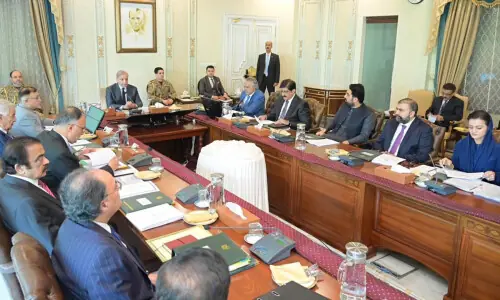
The meeting, which started on Friday and went on into the early hours of Saturday, was attended by the chief diplomats of host Saudi Arabia, Iran, Jordan, Kuwait, Turkey and Syria, all neighbours of Iraq, in addition to Egypt and current Arab League chair, Bahrain.
The ministers “affirmed that the Iraqi people should administer and govern their country by themselves, and any exploitation of their natural resources should be in conformity with the will of the legitimate Iraqi government and its people”, the statement said in a reference to Iraq’s oil wealth.
Stressing their commitment to Iraq’s territorial integrity, the ministers said they also looked forward to the “early establishment of a broad-based and fully representative government in Iraq, in accordance with a constitution to be agreed upon”.
Prince Saud later told reporters the eight countries wanted to see a legitimate Iraqi government set up “immediately if possible,” but pending this, the occupying powers should ensure security in the country.
The eight officials said the UN should have a “central role ... in dealing with the situation in post-war Iraq”, and voiced their governments’ readiness to contribute to the reconstruction of the war-ravaged country.
The ministers “expressed their countries’ disagreement with allegations directed toward Syria”, which has recently been accused by Washington of harbouring both officials of the ousted government and banned weapons smuggled from Iraq, and of producing chemical arms.
They backed Syria’s initiative, through a draft resolution put to the UN Security Council, to turn the Middle East into a zone free of weapons of mass destruction and welcomed news that US Secretary of State Colin Powell planned to visit Damascus.
Despite the show of unity on post-Saddam Iraq, the foreign ministers were reported by Arab diplomats to have differed on some issues, an assessment substantiated by Egypt’s Ahmad Maher when he said that while the eight countries agreed on “essential points”, there could be “divergent analyses” of the situation.
The differences related to the status of the Kurds in the north, Turkish demands on oil from the city of Kirkuk, and some of the figures tipped to become members of a future Iraqi government, one diplomat said.
Maher and a member of the Turkish delegation denied, however, that Turkey had raised the issue of Kirkuk oil during the meeting. The diplomats said there were also differences between Syria and Iran on the one hand, and Kuwait on the other, over the presence of US troops in the Gulf region.
SANCTIONS: The Saudi foreign minister said after the meeting that U.N. sanctions against Iraq should end only when it has a legitimate government.
“Now Iraq is under an occupying power and any request for lifting sanctions must come when there is a legitimate government which represents the people,” Prince Saud said while talking to newsmen.
The United States wants a quick end to the U.N. sanctions to allow oil sales to help fund reconstruction.
“If what they (the occupying forces) intend is the exploitation of Iraqi oil, it will not have any legitimate basis,” the minister said.
Saudi Arabia and Kuwait are concerned that their revenues might be hit if Iraqi oil is once again sold on the open market.—Agencies