



 0
0

 ATHENS, April 16: Leaders from 10 eastern European and Mediterranean states on Wednesday signed a historic treaty setting the seal on their entry into the European Union.
The landmark move marks the end of Europe’s post-war divisions and will enlarge the current 15-member EU into a powerful regional bloc of 450 million people.
The decision was made at an EU submit that began here on Wednesday morning amidst street protests against the US-led war on Iraq.
But EU states remained sharply divided on overhauling the club to cope with enlargement.
Signalling fierce debates ahead on key reforms, a group of 16 smaller states — from both present and future EU members — met for unusual pre-summit talks aimed at challenging what they view as a bid by bigger nations to reduce their influence.
While all governments agree that a revamp of unwieldy EU decision-making is badly needed to avoid paralysis when the 10 new members enter the bloc in May 2004, there is deep discord on key issues, including calls to get rid of the current system under which the EU presidency rotates to a new member every six months.
EU leaders are also hoping that the Athens summit will heal their bitter split over the Iraq war and allow governments to forge a joint stance on a central United Nations role in the post-conflict reconstruction of the country.
UN Secretary-General Kofi Annan wants to secure EU support for a UN presence in Iraq.
EU governments have already said they want the UN to take the lead in rebuilding Iraq and also agree that there must be no US attack on Iraq.
Reuters adds: The 10 acceding countries are: Cyprus, the Czech Republic, Estonia, Hungary, Latvia, Lithuania, Malta, Poland, Slovakia, and Slovenia. They will formally join the EU on May 1, 2004.
The leaders of Bulgaria and Romania, which hope to join the EU in 2007, were also present. Participants also included the leaders of would-be EU candidates such as Croatia and Serbia.
But Turkish leaders stayed away from the ceremony, possibly to mark Ankara’s displeasure that Cyprus has been allowed to join the EU despite the absence of a peace set-tlement between its Greek and Turkish Cypriot populations.
The internationally-recognized Greek Cypriot government conducted the EU accession talks on behalf of the whole island.
AFP adds: British Prime Minister Tony Blair and French President Jacques Chirac, who locked horns over the US-led war on Iraq, held a “very positive” meeting on Wednesday to discuss the post-war future, a spokesman for Mr Blair said.
The “unplanned” meeting took place at the margins of a European Union summit in Athens, and focused on Iraq, the Middle East and EU issues, Mr Blair’s spokesman said.
“By chance he (Blair) had a 25-minute meeting with Mr Chirac. It was very friendly, very useful,” the spokesman told reporters.
“They were each in the conference building. The prime minister went to get some fresh air. Mr Chirac had the same idea. It was completely spontaneous and unplanned.
“They discussed Iraq, the Middle East and European issues. It was a wide range of topics.”
Both leaders agree that the United Nations should play a major role in post-war Iraq.
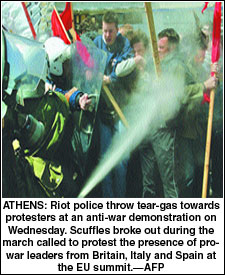
VIOLENCE: Dozens of people were arrested following scuffles at an anti-war march as protesters labelled as “butchers” the pro-war leaders of Britain, Italy and Spain who are in the Greek capital for an EU summit.
With the war in Iraq winding down, young communists and anti-globalization activists massed in the city centre, partly cordoned off by a 10,000-strong police force, to denounce what they called the US occupation of Iraq.
Police estimated the turnout at 3,000 people, Greek media at double that figure — a far cry from the mass anti-war rallies of recent months which drew several hundred thousand into the streets of Athens.
About 100 hooded and masked youths on the protest sidelines hurled Molotov cocktails and other objects at the British, French, Italian and United States embassies and several banks.
Police fired tear gas into the air to scatter the troublemakers, and made dozens of arrests, before the demonstrators marched on, coughing and rubbing their eyes, towards the US embassy.
A white banner splashed with red, and scrawled with the words “Butchers: Aznar, Blair and Berlusconi” stood out from a sea of red and white flags, as the demonstrators filed past the embassies.
The march was called to protest the “undesirable” presence of British Prime Minister Tony Blair and his Spanish and Italian counterparts Jose Maria Aznar and Silvio Berlusconi, Washington’s three main EU allies over the war in Iraq, organizers said.
The three were in Athens for a summit of European Union leaders, the first since the fall of the Iraqi regime of Saddam Hussein, and a signing ceremony that will enable 10 new members to join the European Union next year.




























