0
0

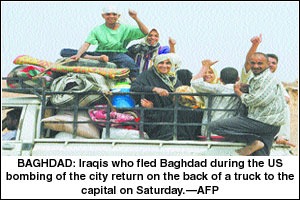 BERLIN, April 12: Saddam Hussein’s top scientific and weapons adviser, one of 55 people on America’s most wanted list of Iraqi leaders, has surrendered to US forces, German public TV station ZDF said on Saturday.
Gen Amer Hammoudi al-Saadi, who liaised with UN weapons inspectors before the invasion, gave himself up to US forces in Baghdad, ZDF said.
The station said one of its camera crews had accompanied Gen Saadi at his request.
His surrender would be the first from the group of 55 the United States wants pursued, killed or captured, ZDF said.
Al Saadi told ZDF he did not know where Saddam Hussein was. He also insisted Iraq did not possess chemical or biological weapons and denied being a member of the Baath Party.
He told ZDF he had stayed at home even after US forces arrived in Baghdad. He said he felt in no way guilty and had therefore voluntarily surrendered to US forces.
While surrendering to US forces, Saddam Hussein’s top weapons adviser insisted that he was ready for questioning because the ousted regime did not have arms of mass destruction.
“I expect to be questioned, to be interrogated about the Iraqi armament program,” General Amer al-Saadi, a rockets specialist and Saddam’s chief weapons adviser, told German television.
“I tell you for history: we have nothing, not to defend the regime,” said Saadi, who was the chief interlocutor of US disarmament experts, referring to US-British accusations that the Saddam regime still had prohibited weapons.
He accused the United States of attacking Iraq “without reason.”
ZDF footage viewed in Baghdad showed Saadi wearing a mustard shirt and black trousers while speaking with his German wife, Helma, his brother and his nephew in the garden of his home in an undisclosed location in the capital.
Then Saadi sat in the back seat of the ZDF van next to the journalist who was interviewing him along the way.
Saadi was seen stepping down from the vehicle near a public bath on Abu Nawas avenue which travels along the eastern bank of the Tigris river, on the opposite side of the US-controlled Republic Palace of Saddam Hussein.
Saadi shook hands with the US troops who told him that he could take along his wife, but the weapons specialist insisted on going alone.
He kissed his wife on the cheek before sitting in the passenger seat of a US military truck that took off to an undisclosed location.
Saadi, an avid tennis player, was carrying only a small sports bag.
A ZDF statement said Saadi declared in an interview to be aired later Saturday that he had no information on the whereabouts of Saddam, who has not given sign of life since a US air strike on a Baghdad building where he was believed to have been present on Monday.
He also denied that Iraq had chemical or biological weapons.
The station said in the statement that Saadi “wished to be accompanied by a ZDF team” when he gave himself up.
ZDF said Saadi appears on a list of the most wanted Iraqis released by the US Defense Department on Friday under the name “Amir Hamudi Hasan” with the title of presidential scientific advisor.
BAGHDAD FIGHTING: US forces fought off an attack on the west bank of the Tigris river in central Baghdad on Saturday evening, and said they had seized one of the last remaining strongholds of “Arab mujahideen” in the city.
Witnesses on the eastern side of the river, around the Palestine Hotel heard heavy machinegun and tank fire from US forces across the river.
The exchange lasted around 20 minutes.
A US official said the enemy opened fire on US troops from six bunkers on the western bank.
“We’re not sure how many of them there were, but they opened fire and now they’re dead,” he said, adding that he guessed there were 15 to 20 Iraqis or other nationals involved.
Earlier, US troops took control of Mansur district in western Baghdad, previously a stronghold of “volunteer fighters” who came to Iraq to help defend against the US-British invasion.
US officials said there had been considerable resistance in the area from remnants of paramilitary forces and “foreign Arab volunteers” in the past three days, but opposition petered out on Saturday morning.
While tanks took up positions near the sprawling Zawra gardens, on the west bank of the Tigris, looters could be seen ransacking nearby ministry buildings, making off with office furniture and computers.
Gangs of youths had blocked streets in the area using sewage pipes and many people could be seen scavenging for food.
The information ministry on the west bank of the river was ablaze. It had already been wrecked by US missile attacks earlier in the month.
In the densely populated northeastern slum area of Saddam City, US Marines pulled back to allow local people to hunt “Mujahideen” holed up in the area.
“The locals said they wanted to take charge of Saddam City and we said: ‘Roger that’,” Lt Col Lew Craparotta, commander of a Marine unit that moved back from the fringes of the suburb, said.
Local leaders told US officials that non-Iraqi Arab fighters were still a threat in the city.
“It’s much easier for them to identify the enemy than for us. We really can’t tell who is who,” Craparotta said.
The US withdrawal will allow local men to carry weapons openly, set up checkpoints and cordon off areas where they suspect the Arab volunteer fighters are hiding.
Col Craparotta said it was not clear how many “third country nationals”, as the US describes them, were in Saddam City.
Iraq has said thousands of volunteers from across the Arab world came to the country to help fight the US-led invasion.
Local militia and the “mujahideen” fought fiercely through Friday night until after dawn, with the sound of sustained small arms and heavy machinegun fire suggesting substantial clashes between the two groups.
On Saturday, sporadic small arms fire erupted in the poor district, indicating the “flushing out” operation was ongoing.
Baghdad is saturated with weapons, so both the militia and the volunteers have easy access to large arms and ammunition caches.—Reuters/AFP