



 0
0

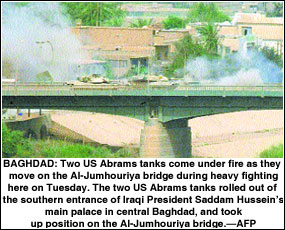 BAGHDAD, April 8: Fighting raged across Baghdad on Tuesday as US troops, backed by tanks and warplanes, battled for control of the city in ferocious clashes.
The Iraqi capital was virtually encircled and US soldiers spanned out further in the city while marines in thousands of armoured vehicles poured in from the east after clearing road jams at a key bridge crossing.
US tanks battled across Baghdad’s main presidential compound — a symbol of President Saddam Hussein’s rule — amid heavy exchanges of tank, artillery and gunfire.
Mystery surrounded the fate of the Iraqi leader after US strikes on Monday obliterated a building where he was believed to be holding a meeting, also attended by his two sons.
Fresh waves of airstrikes pounded the southern and southeastern fringes of the city, while in the centre, two US tanks captured a key bridge over the river Tigris, where they met stiff resistance from Iraqi forces.
US President George Bush, meeting British Prime Minister Tony Blair in Belfast, said he did not know if President Saddam had been killed in the US bomb attack on Monday.
“I don’t know whether he survived ... The only thing I know is that he is losing power... Saddam Hussein will be gone,” Mr Bush said after his third meeting with Mr Blair in as many weeks.
MARINE KILLED: One US Marine was killed and six others wounded in firefights in the suburbs of Baghdad, hours after they had completed their final advance into the capital, US military officials said.
A US commander said that an A-10 Thunderbolt strike aircraft was shot down over Baghdad and crashed, but the pilot ejected and was rescued.
Thousands of armoured vehicles were pouring into the capital, with US military officials saying the end of President Saddam’s clutch on power was near.
“We just continue to seize the initiative, will continue to push. Hopefully the regime will fall. It’s just a matter of time,” said Major Mike Birmingham, from the US infantry.
US forces continued to fan out across Baghdad and were only a few kilometres from encircling the city, officials claimed.
But Iraqi Information Minister Mohammad Said al Sahhaf remained defiant, telling journalists US forces would surrender “or be burned in their tanks”.
Hundreds of families left the capital in intensive bombing, driving eastwards in cars, trucks and minibuses overflowing with mattresses, kitchen utensils, beds and food.
“I’m closing the house and leaving with my family for a safer place. I will come back every now and then to see if something happened,” said Ali Rishek, 53, before driving away with his wife and their three children.
WARNING: The chief of staff of British forces in the Gulf warned of a potential “final act of defiance” by President Saddam, with the collapse of his government looking “inevitable”.
“There is always the possibility that they were able to organize some final act of defiance — and we’ve got to keep on our guard against that,” said Maj Gen Peter Wall.
BASRA: In southern Iraq, a spokesman for British forces said “a couple more days” were needed before the second largest Iraqi city of Basra could be declared secure, a day after Britain said the battle for the city was largely over.
While some Basra residents defaced murals of Saddam after the British entered, thousands looted public buildings and homes of Baath party members.
But one Basra resident said: “The people in Basra feel defeated. Sure, we certainly hated Saddam but we also hate the British and Americans.”
ATTACK ON SADDDAM: The US forces tried to assassinate the Iraqi president on Monday by bombing a building in Baghdad where Saddam Hussein was holding a meeting with senior officials. The president’s two sons also attended the meeting.
US officials said a B-1 bomber had dropped four 900-kg bombs on the building.
The bomber strike that targeted a residential neighbourhood where the Iraqi president made a walkabout on Friday, was part of a campaign of increasingly personal attacks targeting him, close aides and symbols of his power.
The US television news channel MSNBC quoted US officials as saying they believed Saddam and his two sons may have been killed. But Pentagon officials would not confirm the report.
“We just don’t know who might have been killed,” one Washington official said after the assault with bunker-busting bombs in Baghdad’s Al Mansur area.
“Obviously we hope that some part of the leadership was taken out of action, but we don’t know at this point who might have been there at the time the ordnance arrived,” said the official.
At least 14 civilians were killed on Monday by a bomb that destroyed four houses in Al Mansur and left a crater eight metres deep and 15 metres wide off a main commercial artery.
It was the second attempt by US forces to kill President Saddam with a single blow.
HOSPITALS: International aid agencies on Tuesday warned that medical supplies in Baghdad were critically low and hospitals were stretched to the limit coping with wounded from heavy fighting inside the Iraqi capital.
“They have reached the limit of their capacity,” said Nada Doumani, a spokeswoman for the International Committee of the Red Cross (ICRC).
Doumani told a press briefing by aid agencies that Iraqi surgeons and medical staff were working round the clock and running low on medicines and surgical equipment, including anaesthetics.
“When this conflict started we all said there were sufficient supplies in Baghdad for several weeks at least of normal medical operations,” said Iain Simpson, a spokesman for the World Health Organization (WHO).
“This is not a normal medical situation and so supplies are running very low, particularly emergency supplies,” he added.
ICRC was delivering limited emergency stocks in the Iraqi capital, while the WHO said it was trying to gain access for a convoy of trucks from Jordan which was waiting with medical supplies for hospitals in Baghdad.
Power cuts were also hampering work in hospitals and affecting water supplies, which were only being shored up with emergency generators.
“These are very temporary, emergency solutions,” Doumani said after contact earlier on Tuesday with the ICRC’s office in the Iraqi capital.
“The situation in Baghdad is starting to become critical especially with the power cuts,” she added.
The UN Office for the Coordination of Humanitarian Affairs (OCHA) said in a briefing note that the Al-Yarmuk hospital in Baghdad was coping with about 100 wounded an hour.
Another hospital, Mahmudiya, south of Baghdad, was no longer capable of dealing with war wounded, it added.
The aid agencies were not prepared to give an overall estimate of casualties.
“The key is that there is a large volume of civilian casualties,” Simpson said.
Aid officials also reiterated warnings about water shortages throughout central and southern Iraq, which are beginning to have a sharp impact on children.
“What we had believed would be a bad scenario is happening, there are more and more children suffering from diarrhoea because of the lack of water, they drink contaminated water,” Damien Personnaz, a spokesman for the UN Children’s Fund (UNICEF) said.
The UN refugee agency, which had expected several hundred thousand Iraqis to flee the country, said it had still seen no sign of a mass exodus.
“We still have no information about any major influx into neighbouring countries, we still have a trickle,” Kris Janowski, a spokesman for the UNHCR said.
UNICEF estimated that about 10 percent of Iraqi children could suffer very high levels of psychological trauma after the conflict.—AFP




























