0
0

ISLAMABAD, April 7: The advisory committee of the Indus River System Authority (Irsa) meets here on April 9 to approve a water management plan for the Kharif season amid Sindh’s demand that water distribution should be made on the basis of the 1991 water accord instead of historic-use basis.
Sindh’s demand is based on water availability projections for the Kharif season which indicate water shortage from one to seven per cent during the season.
There is no dispute between Sindh and Punjab in case of normal water availability because distribution is made on the basis of proportions set in the 1991 water accord.
The disagreement between the two arises when there is water shortage because section 14(b) of the accord says that shortages should be shared on the historic-use basis. Water use during the years from 1977-82 of acute shortage is normally treated as historic use which favours Punjab.
An Irsa technical committee last week refused to take a decision on the demand from Sindh (for distribution of water on the basis of the 1991 water accord by assuming one per cent shortage as zero), saying it was out of its purview.
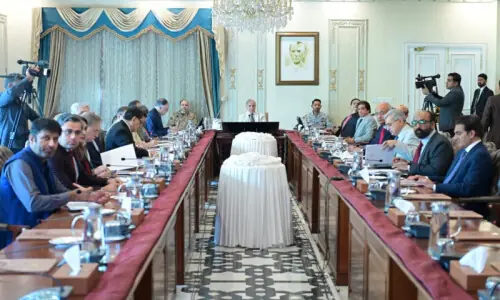
The Irsa meeting to be presided over by Chairman Nasar Ali Rajput would approve the reservoir depletion criterion agreed at the technical committee meeting which entailed that both reservoirs should be depleted simultaneously on a proportionate basis.
The technical committee had also decided that distribution of water would be made on actual annual average basis commonly known as historic-use basis till such time the matter was decided by the higher authorities.
Irsa has the power to distribute water among provinces on the basis of the water accord if it agreed to assume shortage at zero instead of one per cent as suggested by Sindh.
In the most likely scenario, water shortage would be four per cent in early Kharif and overall three per cent throughout the season. The shortage would be just one per cent during the Kharif under a maximum availability estimate, while seven per cent shortage in early Kharif and around 5 per cent in overall terms has been estimated at the minimum water availability scenario.
Sindh has been demanding for the last three years that shortages should be shared among the provinces strictly in accordance with the provincial shares as defined in the water accord. The Punjab, however, insists that in case of shortages the principle of historic-use should prevail.
The principle of shortages sharing on the basis of historic-use currently holds the ground pending a decision by the government whether or not the dispute be referred to the Supreme Court for adjudication.
Following a worst-ever inter-provincial water dispute, the two provinces had asked the chief executive secretariat in November 2001 to get the section 14(b) of the 1991 water accord interpreted by the apex court whether the shortages are to be shared on the water accord basis or the historic-use basis. An status quo has since been maintained which practically favours Punjab.