



 0
0

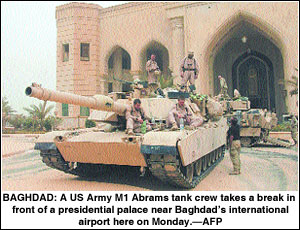 BAGHDAD, April 7: US forces stormed into Baghdad with tanks and troops on Monday, raiding three of Iraqi President Saddam Hussein’s palaces while fierce battles raged across the battered capital.
The US Central Command described it as a raid and not an allout assault on the city, while witnesses said heavy fighting was still raging throughout the day as the death toll from the 19-day-old invasion kept climbing.
Two foreign journalists and two US soldiers were killed in an Iraqi rocket attack on a US position outside Baghdad, which also left 15 US soldiers wounded.
Fourteen people died when a bomb hit a residential area.
While huge explosions and the boom of artillery fire echoed across the city, Iraqi fighters closed off an area around the famed Al Rashid hotel, where a furious gunbattle could be heard.
With hospitals in the city struggling to cope with the flood of dead and injured, hundreds of civilians pressed outside the shut gates of the main bus station, searching in vain for a bus out of Baghdad.
The United States said more than 100 tanks and armoured fighting vehicles were used in the daylight raid, which saw US forces muscle into two palaces, including the sprawling Republican Palace compound.
Explosions and smoke poured from the sprawling 2.5-square kilometre palace, which houses President Saddam’s personal office and an underground bunker designed to withstand nuclear attack.
Eyewitnesses saw 10 US marines in full combat gear and armoured vehicles inside the palace, which has been pounded repeatedly since the invasion began on March 20.
No Iraqi leaders were reported to have been found in the palaces.
Iraq’s Information Minister Mohammed Said al Sahhaf, who has emerged as the public defiant face of the government, told reporters that US troops had not even entered the city in any significant strength, a claim shrugged off by a Central Command spokesman in Qatar.
The United States says the war will not be over until President Saddam and his inner circle are removed from power.
In mid-afternoon, while the fighting was raging, Iraqi television showed the president meeting a senior aide, though there was no way to know when the footage was shot.
The network also showed pictures of President Saddam chairing a meeting of top military and political brass, including his son Qussay, head of the elite Republican Guard.
Vice President Taha Yassin Ramadan, Defence Minister Sultan Hashem Ahmed and army chief Ibrahim Abdul Sattar attended.
The head of the Iraqi presidency, Ahmed Hussein Khudayer, and Latif Nuseif Jasem, a member of the ruling Baath party’s leadership, were also present.
Wearing military uniform, the president was shown sitting behind a desk in a large room with a bay window and drawn curtains. The location was not disclosed.
A large map of Iraq was stuck on the wall behind the Iraqi strongman.
President Saddam has recently been shown frequently on television to demonstrate he is still in charge, chairing a meeting of top aides on Saturday and walking the streets of Baghdad to popular acclaim on Friday.
At Centcom headquarters in Qatar, US Brigadier General Vincent Brooks said that much of Baghdad was no longer in the government’s control, although he did not say if areas had been taken by US troops.
The US has been hoping for a popular uprising to help topple the Iraqi president. The district around the palace, including the ministries of information and foreign affairs, were still in Iraqi hands.
Lt Col Peter Bayer, operations officer for the US army’s Third Infantry Division, said US troops had “secured the main presidential palace” and another palace in the city centre as well as a third near the airport. But he said: “We’ve been significantly challenged.”
Gen Brooks said coalition forces were still facing “pockets of resistance” across the country.
Warplanes roared low during the afternoon. Iraqi anti-aircraft defences opened fire despite minimal visibility due to the thick dust and smoke from oil trench fires covering the city.
Fighting intensified later at the palace compound, where at least three Bradley fighting vehicles fired on the buildings on the banks of the Tigris river.
Troops entered one building after setting fire to surrounding bushes, then blew up a nearby building.
Iraqi paramilitary fighters were seen firing assault rifles and rocket-propelled grenades from different angles toward the area of the Al-Rashid hotel, which they sealed off.
From the southeast, US Marines entered Baghdad undeterred by the blowing up of two bridges on the Diyala River, which runs east of the Iraqi capital. —AFP




























