



 0
0

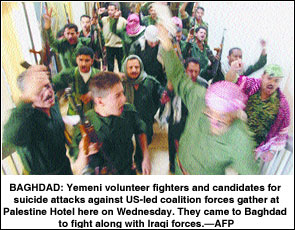 SOUTH OF BAGHDAD, April 2: US forces on Wednesday claimed smashing through elite Iraqi divisions to within 30kms of Baghdad, using fearsome air power to back the swiftest advance yet of the invasion.
US Marines seized a vital bridge over the Tigris river and then pushed along its northern bank towards the Iraqi capital, while the Third Infantry Division thrust northwards after encircling Karbala.
A military source claimed vanguard units were just 30kms from the southern edges of the capital of some five million people — where bombs killed several people at a hospital and some motorists, besides damaging a Red Crescent hospital.
Iraqi television showed President Saddam Hussein smiling and laughing in a meeting with ministers, hours after speculation swirled around world financial markets that he might be dead. It was unclear if the pictures were new.
Some troops had crossed to the east bank of the Euphrates, bridging the main natural obstacle on their route to Baghdad.
Forces heading up the Tigris valley from the southeast were as close as 40kms to the city, the source said.
“The dagger is clearly pointed at the heart of the Baghdad regime,” US Brigadier General Vincent Brooks claimed.
Journalists taken to see civilian casualties of bombing in the town of Hilla, 100kms due south of Baghdad, saw Iraqi forces steeling for a fight but looking relaxed.
Flatbed trailers unloaded tanks by the highway to Baghdad, firmly in Iraqi hands despite the US advance into this area. Petrol pits were set alight to obscure visibility from the air.
The two powerful US columns are now closing on the capital from the south and southeast after an aerial bombardment that battered elite units guarding the city for more than a week.
But most defence experts said US troops were likely to need another four to eight weeks to take Baghdad.
US forces are present in parts of northern and western Iraq, but too few to be able to fight towards Baghdad on those fronts.
President Saddam urged a Kurdish faction controlling part of northern Iraq to side with him against the US-led assault, warning it not to help the United States open a new front.
Gen Brooks said the northward thrust, just before the invasion enters its third week, had taken some US troops across a “red line” around Baghdad — into the area where the military believes Iraqi forces might be most likely to launch a poison-gas attack.
“If it’s used, we’ll be prepared,” he said. “It causes us to maintain protective postures of our forces as they approach this area, but it doesn’t make us stop.”
The spokesman claimed US troops had destroyed the Baghdad Division of the Republican Guard near the town of Kut, 170kms southeast of Baghdad, and had fought two other Guard divisions.
Two huge US bombs exploded near Kut, sending up giant mushroom clouds.
However, Iraq dismissed as illusions reports US forces had crossed the Tigris or made gains elsewhere, and an army spokesman said the Baghdad Division was in control and “enjoys high morale to fight the enemy and destroy it”.
In Baghdad, bombs killed several motorists and damaged a Red Crescent hospital. At least five cars were crushed, their drivers burned to death.
Hospital sources said at least 25 people, including patients, were wounded in daylight raids which also pulverized buildings in a trade fair, next to a government security office.
US planes pounded central Baghdad, striking at least three times a compound where President Saddam’s son Qusay, commander of the Republican Guard, has his headquarters.
Iraqi Information Minister Mohammed Saeed al Sahaf said air strikes had killed 24 civilians and wounded 186 on Wednesday and Tuesday night, with 10 dead and 90 wounded in Baghdad alone.
“No matter how many Iraqi civilians they kill, this will make us even stronger and even more determined to repel the invasion and to defeat them,” Mr Sahaf said.
City defenders have been preparing for urban warfare. Pick-up trucks equipped with machineguns and anti-aircraft guns are dotted across the city.
On world markets, the rapid US offensive pleased investors hoping for a speedy end to the war. Stocks and the dollar rose, oil tumbled and traditional safe haven assets fell sharply.
In the north, B-52s pummelled frontlines near Mosul city and bombed targets near the oil hub of Kirkuk.
Helicopters and fighter planes strafed Fedayeen militia active in Najaf, central Iraq.
Mr Sahaf accused the Americans of bombing shrines there, while a US spokesman accused Iraqi forces in Najaf of firing from the gold-domed shrine of Hazrat Ali. The Americans did not return fire, he said.
The advances on the broad Euphrates and Tigris, which flows through Baghdad, came after US troops halted their push for the capital for several days to bolster vulnerable supply lines.
DECISIVE PHASE: The commander of British forces in Iraq, Air Marshall Brian Burridge, said the decisive phase of the war had begun but might not end soon. “Decisive phases often take time,” he said.
“We need to proceed with great delicacy in Baghdad,” he said. “We don’t want to cause any more damage to the place than is necessary and we certainly don’t want to add to civilian casualties.”
The US-led forces want to win over the sympathies of Iraqis, who have proved far more hostile to invasion than the troops were led to believe, but a promised flow of humanitarian aid into Iraq is still being held up by security fears.
Iraq says more than 650 civilians have been killed and more than 4,000 wounded during the invasion. Grisly television images of Iraqi casualties have fuelled Arab anger over the invasion. —Reuters




























