0
0

 HARIR (Iraq), March 27: US troops parachuted into Kurdish-held northern Iraq on Thursday to open a new front against President Saddam Hussein, as relentless bombing shook Baghdad for an eighth day.
Iraq said the week-old conflict had caused more than 4,000 civilian casualties, including more than 350 dead.
“This is the beginning of the northern front,” a US defence official said, after 1,000 paratroopers from the 173rd Airborne Brigade jumped into northern Iraq before dawn.
Witnesses later saw about 100 soldiers and two transport helicopters landing at the Harir airfield, 75kms northeast of the Kurdish city of Arbil.
Kurdish fighters were seen helping the Americans. The US military said it would support “a robust flow of follow-on forces”.
Three mighty explosions hit central Baghdad on Thursday afternoon after dozens of blasts jangled the nerves of sleepless residents overnight.
“There were three very powerful blasts, close by,” a resident said. “There are warplanes overhead and anti-aircraft fire.”
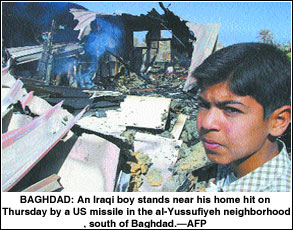
The latest raids followed carnage on Wednesday when 15 civilians were killed by a twin US missile strike on a market area in the north of the city.
A US official said errant US weapons might have been to blame for the blasts.
Issuing the Iraqi casualty figures, Health Minister Umeed Midhat Mubarak said 36 civilians had died in air raids on the capital in the past 24 hours.
SANDSTORMS:With clear skies replacing the blinding sandstorms of the previous two days, Iraqi troops set fire to more oil-filled trenches around Baghdad, sending black smoke billowing up to try to hamper US and British pilots attacking the city.
A US official said the better weather would allow more military operations in the next few days.
The British military claimed destroying 14 Iraqi tanks and four armoured troop carriers that made the latest of several attempts to break out of Basra.
“It was a very quick, short, sharp engagement. They were all destroyed,” said a British spokesman.
The US-led forces claimed smashing a column of Iraqi tanks and armoured vehicles that tried to move south from Basra on Wednesday night. On Tuesday, a British naval commander said his forces had blocked a similar attempted breakout by up to 50 tanks.
A week ago US President George Bush launched the invasion with a bomb and missile strike aimed at killing President Saddam.
The Iraqi leader survived to urge his people to resist an invasion that has been slowed by fierce guerrilla-style attacks.
Mr Bush hailed the fast advance north from Kuwait, but on Thursday said the war was “far from over”, changing a speech at the last minute to erase an assessment that the campaign was “ahead of schedule”.
Worried investors took note. Oil and safe-haven gold and bond prices rose, the dollar eased and share prices sank.
The commander of British forces in the Gulf said it would take three months and about one billion dollars to repair Iraq’s neglected giant Rumaila oilfield, allowing exports to flow.
TURKISH OBSTACLE: The arrival of paratroopers from a US base in Italy is a move to threaten Baghdad from the north. Turkey threw a spanner into earlier US war plans by refusing to let up to 62,000 American troops cross its territory into Iraq.
The paratroops, to be reinforced with tanks, could menace Iraqi Republican Guards who have been girding for battle south of the capital rather than in the north.
But a British defence source said the first priority of the paratroops was to bolster Kurdish lines, not to attack Baghdad.
The new force is still tiny compared with the tens of thousands of soldiers pushing across the southern desert towards Baghdad. Some US critics have said even those units are too light and that their supply lines are dangerously stretched.
The United States said it would fly more than 30,000 troops to the Gulf within days to reinforce the 280,000-strong US-British force already committed to the attack.
US and British troops have battled Iraqis all over the south, from the port of Umm Qasr to Karbala, experiencing setbacks that have included helicopter crashes, “friendly fire” casualties and hit-and-run raids on their supply lines.—Reuters