0
0

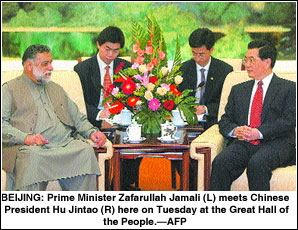 BEIJING, March 25: Prime Minister Mir Zafarullah Jamali said here on Tuesday Pakistan was obliged to develop nuclear option in order to restore strategic balance, which was particularly disrupted by the Indian nuclear tests in 1998.
Maintaining “deterrence is essential” for the country’s security and a key element of balance in the region, Mr Jamali said.
He was speaking to a distinguished gathering of scholars and political analysts in Beijing at a welcoming luncheon, hosted by Madam He Luli, Vice Chairman of the Standing Committee of the National People’s Congress.
Emphasising the need for exercising restraint, he said Pakistan would not engage in any disastrous arms race. “We will only maintain a credible level of deterrence and conventional preparedness to be able to defend ourselves and resist the tendency of domination and hegemony in the region.”
However, the prime minister said, Pakistan could not remain oblivious of the massive increases in arms expenditure by India.
In this regard, he referred to the Indian military ambitions reaching beyond South Asia and the Indian Ocean regions.
He said India was developing two separate blue water navies for the western and eastern regions of the Indian Ocean. “Its nuclear doctrine calls for the development of a triad of air-land-and sea-based nuclear assets.”
DIVERSION: Mr Jamali observed that this entailed diversion of large resources of the region, away from meeting the demand of economic development and poverty reduction.
He termed it as a regrettable drain on limited resources of a region, which needed to address the enormous problems of socio-economic development. “South Asia has the largest number of people in a single region of the world, who live below the poverty line,” he pointed out.
The prime minister said: “The region faces many challenges for ensuring basic welfare of the people, especially in the education and health sectors.” He emphasised that the countries of South Asia needed cooperation to achieve these objectives.
He said that was exactly the purpose of the seven-member South Asian Association for Regional Cooperation (Saarc).
But unfortunately, he observed, the organization had been severely constrained by tensions between Pakistan and India and caused delay in holding the Saarc summit in Islamabad early this year.
He said Saarc was a ready instrument that could help in improving the environment and reducing tension but, he added: “Political will is needed to move in that direction.”
TALKS OFFER: The prime minister underscored a just resolution of the long-standing Kashmir dispute for peace in South Asia, and reiterated Pakistan’s offer to India to begin a process of dialogue on all outstanding issues.
“In today’s world there is no alternative to a dialogue.”
“My government reiterates our offer of dialogue to India. We must begin a process of talks in an effort to resolve problems,” he said while narrating Pakistan’s policy on peace and security in South Asia.
Mr Jamali said the process would pave the way for confidence-building and improvement of political environment in the region needed for the settlement of all issues.
However, he made it clear that in South Asia, the principal source of tension between Pakistan and India had been the 50-year old Jammu and Kashmir dispute.
“A just solution of this issue will lead to normalization of relations between the two major countries of South Asia and will allow nearly one-and a-half billion people of this region to use their energies for economic development,” the prime minister said.
He, however, regretted that efforts for peace had remained fruitless for over 50 years. “India refuses to respect the UN Security Council resolutions calling for free and fair plebiscite to determine the wishes of the Kashmiri people,” he added.
He pointed out towards the massive deployment of over 600,000 Indian troops and security forces in Kashmir who continued to suppress the basic rights of the Kashmiris.
Mr Jamali also referred to the Indian efforts to exploit the international sentiments against terrorism and try to project the Kashmir dispute as a problem of terrorism.
“This cannot mislead the international community. The character of the Kashmir dispute has been defined by the UN Security Council resolutions and it cannot be altered because of Indian campaign to malign the Kashmiri struggle,” he stressed.
Mr Jamali recalled the stand-off with India last year during which New Delhi resorted to military pressure tactics by mobilizing nearly one million troops against Pakistan along the Line of Control (LoC) and on the international border. “These moves created a highly dangerous situation,” he added.
RESTRAINT: He told the Chinese analysts Pakistan maintained a policy of restraint and kept insisting on the need for de-escalation and dialogue to avoid a dangerous conflict between two nuclear capable neighbours.
The policy, he said, found resonance internationally. Mr Jamali in particular recalled China’s support to the need for de-escalation and dialogue.
He said India eventually realized the futility of its massive troops mobilization and began their relocation in November last, incurring considerable expenditure. But, he went on to say, India continued to pursue a policy of unrelenting hostility toward Pakistan.—APP