0
0

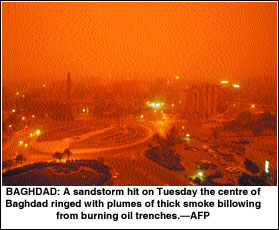 NASSIRIYA, March 25: Warplanes hammered elite Republican Guards defending Baghdad on Tuesday as US armoured columns, slowed by blinding sandstorms, closed in for the decisive fight for the Iraqi capital.
As the battle for Baghdad neared, the US army warned Iraqi civilians to stay at home, keep off the roads and away from the battlefield. “Stay at home, stay calm...do not get out and drive around. The battlefield is a dangerous place,” an official advised Iraqi civilians.
In southern Iraq, US Marines finally punched past Iraqi resistance to cross the Euphrates river at Nassiriya. But they met a fresh ambush on the road north, despite an air strike that killed at least 30 Iraqis apparently heading into battle.
Military officials claimed at a briefing at the Central Command in Qatar that US paratroopers had seized a desert landing strip on Monday night and that six Iraqi jamming systems aimed at disrupting satellite positioning equipment had been destroyed.
A spokesman said the invading force had not yet found weapons of mass destruction that are the stated reason for the war, but repeated earlier US assertions that they would likely be found closer to the seat of President Saddam Hussein’s government.
“Baghdad is really the heart of the regime and I would expect they would hold their most valuable treasure closer to their heart,” Maj-Gen Renuart said at the news conference in Qatar.
In the far south, British and US commanders claimed they had finally snuffed out resistance by the Iraqis in the deepwater port of Umm Qasr, which could now be opened to aid supplies for the local populace.
But, as the war aimed at toppling President Saddam Hussein stretched to a sixth day, Iraqi officials said US and British hopes of a quick and easy victory were fizzling out.
And, as the battle front moved closer to Baghdad, Chairman of the US Joint Chiefs of Staff, Gen Richard Myers, said: “We think the toughest fighting is ahead of us.”
Waves of air raids hit Baghdad’s outer defences, sending shock waves from distant blasts thudding into the city.
“It’s a really heavy attack,” an eyewitness said. “Even though the explosions are quite far away, they are shaking buildings in the centre of the city.”
The Medina Division of Republican Guards stands between Baghdad and US armoured columns that have thrust to the Kerbala area, 95kms south of the capital.
The witness said warplanes could be heard but not seen through duststorms and smoke from blazing oil-trenches around Baghdad.
“The Medina division is now under heavy air attack, although poor weather will hamper this,” British Prime Minister Tony Blair said in London. “Since military action began, a huge amount has already been achieved.”
On Tuesday morning choking duststorms cut visibility to five metres in places and brought convoys to a halt at times.
A British defence source said troops approaching the capital would pause while support lines are strengthened. Military analysts have suggested the advance is dangerously extended.
1,400 SORTIES: At the briefing in Qatar, Maj-Gen Victor Renuart said some 1,400 air sorties were expected on Tuesday, focusing on the Republican Guard, but he admitted the bad weather had affected the ground forces.
“Weather has had an impact on the battlefield with high winds, with some rain, with some thunderstorms, and that’s occurred really throughout the country, so it’s not been a terribly comfortable day on the battlefield,” Gen Renuart said.
However, he added, high-tech weaponry had allowed the US-led forces to keep the pressure on.
Another general, at the same briefing, claimed US paratroopers had seized an Iraqi desert landing strip on Monday night, despite darkness and bad weather.
“The bottomline is that we are on track.”—Reuters