0
0

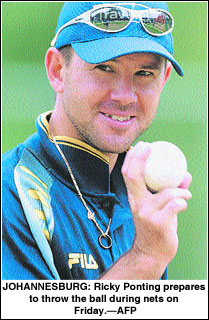 JOHANNESBURG, March 21: Australian cricket selectors are ruthless, unsentimental, pragmatic and usually get it right.
A losing run against New Zealand in a tri-series last year and indifferent personal form spelt the end for Steve Waugh as national one-day captain.
One of Waugh’s few unrealised ambitions was to become the first captain to retain the World Cup. Despite strenuous efforts to regain his place he remains out in the cold, watching Australia’s 2003 campaign from afar.
With Shane Warne ruled out after one off-field indiscretion too many, the selectors turned to Ricky Ponting, the first Tasmanian to lead Australia.
Ponting has led Australia to a record 16 one-day victories and plans to make it 17 over the weekend. He was rewarded earlier in the week when he was named as Steve Waugh’s Test vice-captain.
The Australians like to keep it simple when it comes to selecting their national captain, a job which holds more prestige than that of the prime minister.
They usually appoint the team’s best batsman, a post-war line running through Don Bradman, Lindsay Hassett, Bob Simpson, Bill Lawry, the Chappell brothers Ian and Greg, Allan Border, Mark Taylor and Waugh. Richie Benaud, the flamboyant all-rounder who is now the most respected pundit in the game, was a notable exception.
Ponting was not an automatic choice to take over from Waugh.
He was thrown out of a Kolkata discotheque in March 1998 and 10 months later he was punched unconscious in a bar in Sydney’s Kings Cross. He admitted to a problem with alcohol and was handed a suspended three-month ban.
“I let down my team mates, my family and Tasmania and Australian cricket,” he said. “I have a problem with alcohol at times.”
Ponting fought his way back, realising what he had almost thrown away. “The turnaround was all about maturity,” he said. “I realised what it really meant to play for Australia.”
Ponting is also an fanatical gambler, leading to the predictable nickname ‘Punter’. He followed his father and grandfather by sharing their passion for dog racing and owns several greyhounds.
Gambling is part of the Australian character and Ian Chappell, for one, believes it enhanced his captaincy credentials.
“He has the cricket brain and he’s a punter,” Chappell said. “The gambling instinct is important as a captain.”
Ponting’s cricketing pedigree is impeccable. He bats at number three, again following Bradman, Hassett and Ian Chappell in a spot where a batsman can dictate the course of a match.
Quick-footed, aggressive with a liking for the hook and the square-cut, Ponting’s statistics are mightily impressive. He averages 47 in Test matches and could yet raise the mark to 50, the accepted hallmark of a great batsman.
In one-day matches he averages an equally impressive 40. With the retirement of Jonty Rhodes, he is the best cover-point in the game.
“Defensively he is solid but he also seizes on anything loose straight away,” said Warne. “What makes him so difficult to bowl to is the tight margin for error. Anything short, he will cut or pull, so you have to try to keep a fullish length.
“Over pitch, though, and he will drive straight, the sign of a top-class batsman.”
Despite his disappointment at losing the one-day captaincy, Waugh approved the choice of Ponting as his successor. “Ricky’s a tough nut,” he said. “He’s a really good choice.”
Australians value unpretentious toughness, a quality Ponting exhibited from the start.
Born in Launceston on Dec 19, 1974, he was given a T-shirt at the age of six by his grandmother bearing the inscription “Inside this shirt there is a future Test cricketer”.
He made his debut for Tasmania at the age of 17, scoring 56 against South Australia. In his Test debut against Sri Lanka in the 1995-6 season, he showed his confidence by wearing the baggy green hat instead of a helmet and was dismissed only four short of a century.
Waugh remembers playing an early state match for New South Wales against the precocious Tasmanian. “I remember wondering about this young punk, he was so chirpy and competitive.”
Ponting’s status in the national team was recognised when he was entrusted with leading the singing for the after-match team anthem “Under the Southern Cross I Stand”, an honour passed down through Rodney Marsh, another tough Tasmanian David Boon and Queensland wicket-keeper Ian Healy.
Former Australia all-rounder Tom Moody recalls Ponting leading the singing in the centre at Lord’s, some seven hours after Australia won the 1999 World Cup final against Pakistan. “He stood on my shoulders,” he said.
With Waugh named on Monday as captain of the Australia team to tour West Indies, Ponting will have to wait for the ultimate honour. In the meantime there is a World Cup to win and a target of 17 straight one-day wins.
“Records like that sure mean a lot when you sit back and look at them in a little while,” he said. “As a team we have spoken about it. It’s a nice thing, a result of playing good cricket.”—Reuters