0
0

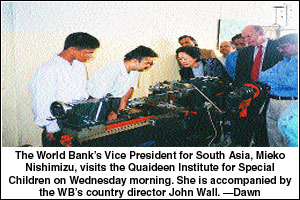 KARACHI, March 19: World Bank’s Vice President for South Asia Mieko Nishimizu has said that a country cannot truly get rid of poverty if its handicapped people are not fully rehabilitated and reintegrated into society.
Talking to Dawn after her visit to the Quaideen Institute for Special Children in Gulistan-i-Jauhar, Ms. Nishimizu observed that in Pakistan a comparatively larger percentage of population was unfortunately affected with different kinds of handicaps, so it was essential that this section of the population was given special attention, and empowered so that they do not face any difficulties in leading a normal life.
She said her visit was part of a learning process to understand what was available in the institutes and what kind of facilities were being provided to the special students and what were their needs.
She said that at present there was no project under consideration by the World Bank, but providing funding, no doubt necessary, was not the only thing required. Equally, or even more, important was the commitment and dedication of the people towards the cause, she said.
She said that after requests by the government, her organization might provide “meaningful assistance”, like equipment, etc., to further improve the services being provided to the special people here.
She emphasized that it is not always monetary support which is most important, and sometimes it is transfer of knowledge and sharing best practices gathered from all over the world that make the difference.
With tears in her eyes, she said she had noticed that the children were trying to learn to overcome their handicaps and they would hopefully succeed.
She praised the teaching staff and said she was moved to see that the parents-teachers association was also very actively cooperating in running the institute.
Three institutions — Quaideen Special Education Centre for the Mentally Retarded; Shaheed-i-Millat Special Education Centre for Visually Handicapped Persons; and Vocational Training Centre for Disabled Persons, — are working in this federal government-run complex.
She said the staff teaching these children was, in fact, serving the humanity — a quality that others should learn from them.
World Bank’s country director John Wall said he was impressed to see that the PTA was not only participating in almost all areas of the institute but was also helping to raise nearly half of the budget of the organization.
He hoped that with proper training, the disabled people would not only learn basic skills, but one day they would be fully empowered and integrated in the social life as useful citizens.
He said at present the World Bank was watching what the people and the governments were already doing and what was needed. His organization might like to provide some “meaningful support”, he added.
Earlier, the World Bank officials visited various sections of the institution and mingled with the children.
Ms. Nishimizu spoke to children who were being provided various vocational trainings.
She also evinced interest in the handicrafts made by the students. The children also gifted a few of their handicrafts. The one-hour scheduled visit of the centre, owing to the interest shown by visitors, was extended to over a couple of hours.
Regional director and in charge of the complex, Fareed Ahmad Yusfani, who took the visitors on the tour of the complex, said that besides traditional subjects, vocational training in computers, mechanical, electrical, tailoring, embroidery, packing, carpentry, cooking, candle-making, sweater weaving, etc was being provided to the children.
The PTA representatives Syed Mohammed Aqeel, Jamshed Raza Zaidi also spoke.