



 0
0

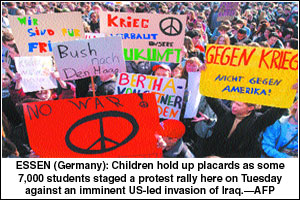 BAGHDAD, March 18: A defiant Iraq on Tuesday rejected a US ultimatum giving President Saddam Hussein 48 hours to go into exile or face war.
In Washington, officials claimed the United States had the support of 45 countries for a military showdown.
With 280,000 US and British troops stationed in the Gulf awaiting orders to invade and UN inspectors and foreign diplomats fleeing the region, president Saddam vowed his forces would repel the United States.
“This battle will be Iraq’s last battle against the tyrannous villains and the last battle of aggression undertaken by America against the Arabs,” he declared.
US President George Bush issued the 48-hour deadline on Monday night after the collapse in acrimony of diplomatic efforts at the UN Security Council to rid Iraq of alleged weapons of mass destruction.
“The tyrant will soon be gone,” Mr Bush declared. “Saddam Hussein and his sons must leave Iraq within 48 hours. Their refusal to do so will result in military conflict commenced at a time of our choosing.”
Mr Bush issued his warning just hours after Washington abandoned efforts to win United Nations backing for military action, apparently unable to rally the nine Security Council votes needed for a new resolution.
With the deadline set to expire at 0100 GMT (6am PST) on Thursday, UN weapons inspectors were evacuated to Cyprus, four months after they had returned to Iraq to verify Baghdad has no weapons of mass destruction.
“I think that we have done our task. It’s unfortunate that we have to leave now. Our job is unfinished, but I think all the inspectors and support staff have done their best,” said their spokesman Hiro Ueki.
When inspectors last withdrew in December 1998, the United States and Britain launched air strikes on Baghdad within hours.
Secretary of State Colin Powell said 45 nations backed the US coalition, although several countries were locked in last-ditch attempts to avoid an invasion.
In Iraq’s first reaction to the ultimatum, Saddam’s elder son Uday said: “This proposition was made by an inept individual. We will go one better by calling for Bush to leave power with his family.”
“Any aggression against Iraq will make them (the Americans) regret their tragic fate and the wives and mothers of the Americans who fight us will cry tears of blood. They should not think themselves safe anywhere in Iraq or abroad,” he warned.
Bracing for possible terrorist strikes, the United States raised its alert to the second-highest level at home and abroad and governments across Europe stepped up security.
Thousands of US marines set off in tanks, armoured vehicles and trucks across the Kuwaiti desert to take up battle positions, and Lt Gen William Wallace, commander of the army’s Fifth Corps in Kuwait, predicted the American-led forces would roll over the Iraqis in “days, maybe weeks”.
On world financial markets, where investors expect the war to be over quickly, stocks and the dollar were chased higher while oil prices plummeted.
Despite the imminent strikes, the Security Council was to meet on Wednesday to study the work of the inspectors, although foreign ministers from Britain and the United States said they would not be there.
In a last-gasp move to avoid conflict, Chinese President Hu Jintao Hu spoke by phone with Bush as well as French President Jacques Chirac and Russian President Vladimir Putin.
“The door to peace cannot be closed,” he said.
The Vatican scolded Bush for assuming a “grave responsibility before God” in deciding that diplomacy had been exhausted.
Moscow also said it believed there was still room for diplomacy, and the Russian parliament postponed ratification of a key disarmament treaty in protest at the US ultimatum.
Mr Chirac, blamed by Bush for blocking Security Council consensus, defended his position saying: “(Iraq) today does not represent an immediate threat that justifies an immediate war.”
German Chancellor Gerhard Schroeder said Saddam did not pose enough of a threat to justify war “which will result in the deaths of thousands of innocent men, women and children.”
Among Bush’s allies, British Prime Minister Tony Blair was seeking parliamentary backing for military action involving some 45,000 British troops, unshaken by tfhe protest resignations of three of his government ministers.
The Turkish parliament was also set to vote on Wednesday or Thursday on whether to provide logistical support to the United States, after its earlier rejection of a US request to deploy 62,000 soldiers.
The United States pressured Turkey, the only Muslim member of NATO and the only one bordering Iraq, to at least allow overflights by US planes, with billions of dollars in aid under threat.
A US envoy was also meeting Turkish officials and Iraqi Kurdish leaders in an attempt to ease tensions between them.
Turkey wants to send troops across its southeastern border into Kurdish-controlled northern Iraq, dreading that its worst nightmare — an independent Kurdish state — is in the making there and could encourage the independence aims of its own restive Kurdish population.
The Iraqi Kurds have threatened to fight the Turkish army if it intervenes in their region, which since the 1991 war has enjoyed de facto autonomy from Baghdad.
Australia has committed 2,000 military personnel to the US-led force, while Poland announced it would send up to 200 soldiers to take part in an attack.
But Spain, co-sponsor of the now-abandoned Iraq resolution, said it would not be sending any soldiers.
In Israel, which was struck by Iraqi Scud missiles in the 1991 Gulf War, the army ordered the population to prepare hermetically sealed rooms and stock up on provisions in case of a possible Iraqi chemical attack. —AFP





























