0
0

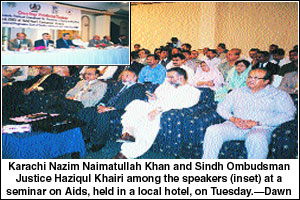 KARACHI, March 18: Representatives of the district government system, Sindh AIDS Control Programme and other stakeholders vowed on Tuesday to join hands in a joint initiative to control the spread of HIV and AIDS in the province. Hepatitis B and C are also proposed to be dealt with under the planned campaign.
Under the joint initiative, which took birth at the event titled “Seminar to Promote Political Commitment for Prevention and Control of HIV/AIDS”, task forces would be constituted for 18 towns of Karachi, besides other districts of the province.
The seminar was organized by the Sindh AIDS Control Programme in collaboration with UNAIDS and UNDP.
The proposed task forces would be headed by the Nazims of the towns or districts concerned. The District Officers (Preventive) of various towns and districts are proposed to be the secretaries.
Some officials belonging to the provincial health department, besides representatives of the districts’ blood transfusion services, media organizations and non-governmental organizations will be the members of the task force.
According to the chief of Sindh Aids Control Programme, Dr Sharaf Ali Shah, the task forces would be responsible for monitoring and evaluating the performance of the stakeholders in implementing the relevant policies.
In this regard, the provincial AIDS Control Programme will be assisting the district government officials in financial, professional and technical spheres. “That is to say, we will train the district government officials and also provide them financial assistance,” said Dr Shah.
Every speech that followed Dr Shah’s, underscored the need for a multi-sectoral programme for the eradication of HIV and AIDS. Dr Suleman Otho of the Karachi City District Government pointed out that 3,700 councillors of Sindh would be monitoring the implementation of the governmental policies.
He added that under the proposed initiative, spread of not only HIV and AIDS, but hepatitis B and C would also be monitored.
Dr Syed Abdul Mujeeb of the JPMC, in his presentation which was based on scientific surveys, described various modes of transmission of HIV and hepatitis B and C. He was of the view that the blood transfusion system was far from safe.
Dr Mujeeb also blamed the overuse and reuse of syringes for the spread of HIV and hepatitis. He said Pakistan was the country where most injections were prescribed per year per person.
Dr Asif Mirza said if the District Nazims utilized the non-governmental organizations properly, up to 80 per cent of the resources needed for any project could be provided by the community. “In such a scenario, only 20 per cent of the resources would have to be provided by the government.”
The only speech which showed that not all was well so far as the proposed initiative was concerned, ironically, was the one made by the City Nazim, Naimatullah Khan. The words he used in his speech, and also the manner in which they were uttered, indicated that proper implementation of the proposed plan was far from being a certainty.
For instance, he said that if allowed to play their due role, the Nazims could stop the HIV and hepatitis from spreading.
Mr Khan said that people belonging to the District Government system were ready to hold 12 seminars every year on HIV and AIDS. He added that provincial ministers were not interested in worthwhile pursuits.
“Otherwise they would have been here today to appreciate the role the District Government people could play in the proposed plan. But they are not. This speaks volumes about their commitment.”